In July 2026, the North American Electric Reliability Corporation issued its highest-level alert. An AI data center had triggered a 1,800-megawatt drop on the regional grid. That is the output of a nuclear reactor vanishing in minutes.
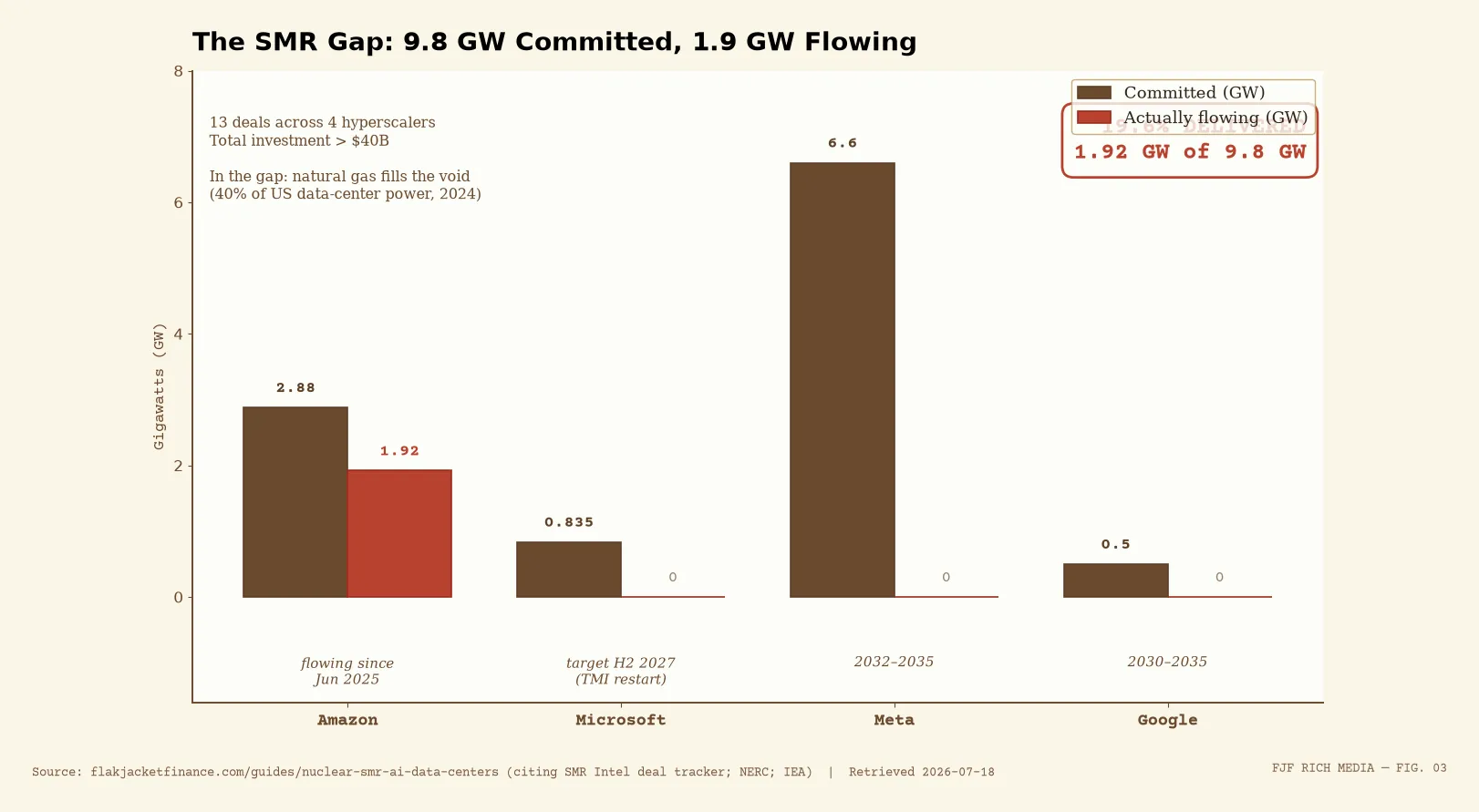
The same month, the four largest hyperscalers — Microsoft, Amazon, Google, and Meta — had collectively committed over 9.8 gigawatts of nuclear capacity across 13 announced deals, per the SMR Intel deal tracker. Total investment exceeds $40 billion.
Here is the number that matters: 1.92 gigawatts of that 9.8 is actually flowing. Nineteen point six percent. The rest is contracts, press releases, and construction timelines that run from 2027 to 2035.
The AI revolution has a power problem, and Big Tech has decided nuclear is the answer. Whether nuclear can deliver on the timeline AI demands is a different question.
The Deals, Ranked by Credibility
The most advanced deal is Microsoft’s. In September 2024, the company signed a 20-year power purchase agreement with Constellation Energy to restart Three Mile Island Unit 1 — the reactor that shut down in 2019 for economic reasons and sits on the same site as the 1979 partial meltdown, though a different unit. The restart costs $1.6 billion. The facility, renamed the Crane Clean Energy Center, will produce 835 megawatts. The Federal Energy Regulatory Commission approved a transmission waiver on June 1, 2026. Target: second half of 2027.
That is a restarted conventional reactor, not an SMR. The distinction matters.
Amazon has the most operational capacity today. Its 17-year PPA with Talen Energy for 1.92 gigawatts from the Susquehanna nuclear plant in Pennsylvania has been flowing since June 2025. Amazon also led a $700 million investment in X-energy, committing to up to 960 megawatts of Xe-100 small modular reactors at the Cascade Advanced Energy Facility near Richland, Washington. Construction starts by end of decade. Operations in the 2030s.
Google signed the first corporate SMR fleet agreement in October 2024, partnering with Kairos Power for up to 500 megawatts. The first 50-megawatt demonstration reactor at TVA’s Clinch River site in Tennessee targets 2030. The full fleet rolls out 2030 to 2035.
Meta announced the largest commitment in February 2026: up to 6.6 gigawatts across TerraPower, Oklo, Vistra, and Constellation. Delivery targets 2032 to 2035. Every deal in that portfolio is a reactor that has never been built at commercial scale.
What an SMR Actually Is
A small modular reactor is a nuclear fission reactor with electrical output under 300 megawatts. Conventional large reactors produce 1,000 to 1,700 megawatts. The SMR pitch has three parts: factory fabrication, modularity, and siting flexibility. You build the reactor in a factory, ship it to the site, and scale capacity in 80-to-300-megawatt increments as demand grows.
The reactor designs in active development tell you where the technology stands as of July 2026.
GE Vernova Hitachi’s BWRX-300 is a 300-megawatt boiling water reactor under construction at Ontario Power Generation’s Darlington site in Canada. Price tag: CAD $7.7 billion. Target: end of 2029. BWX Technologies is manufacturing the reactor pressure vessel. This is the most credible project in the Western pipeline — it has a construction license, a manufacturer, and a utility with federal government backing.
TerraPower’s Natrium is a 345-megawatt sodium fast reactor in Kemmerer, Wyoming. Groundbreaking was June 2024. In March 2026, the NRC issued the first advanced reactor construction permit in U.S. history for this project. Target: 2030.
X-energy’s Xe-100 is an 80-megawatt pebble-bed, helium-cooled reactor. Four units would produce 320 megawatts at the Cascade facility. NRC construction permit is under review.
Kairos Power’s KP-FHR is a 140-megawatt fluoride salt-cooled reactor using pebble fuel. The Hermes 2 demonstration unit is planned at TVA’s Clinch River site. Target: 2030.
Oklo’s Aurora is a 15-to-50-megawatt fast fission reactor using metal fuel. New license application in progress.
Every Western design on that list is in construction, licensing, or demonstration. Zero are in commercial operation. China’s Linglong One (ACP100) reached commercial operation in the first half of 2026, making China the first nation to operate a land-based grid-scale SMR. The United States has not deployed one.
The Timeline Problem
The first-of-a-kind SMR cost estimates run $80 to $150 per megawatt-hour, per SMR Intel benchmarking from March 2026. The target for commercially competitive nth-of-a-kind units is $60 to $80. Nobody has reached nth-of-a-kind yet because nobody has reached first-of-a-kind at commercial scale.
The International Energy Agency projects nuclear will supply over half of U.S. data center electricity by 2035. That projection requires the SMR pipeline to execute on schedule. Every SMR project in the current pipeline has slipped at least once. The Darlington BWRX-300 is the anchor — if it delivers on time and on budget, dozens of planned replications in the U.S., U.K., Poland, and Estonia become more credible. If it slips, the entire SMR thesis slips with it.
The tension is structural. Small modular reactor deployments target 2030 to 2035. AI data center demand is accelerating now. Harvard Business Review flagged this plainly: nuclear is the right long-term answer running on the wrong timeline for the near-term problem.
In the gap between commitment and delivery, natural gas fills the void. As of 2024, natural gas accounts for more than 40 percent of U.S. data center electricity. Virginia alone permitted 27 gigawatts of diesel generator capacity by end of 2025 — the equivalent output needed to power 20 million American homes. The AI boom, at the infrastructure level, is currently a fossil fuel boom wearing a nuclear future on its letterhead.
What Happened in July 2026
The Department of Energy’s Nuclear Reactor Pilot Program selected 11 advanced reactor companies for a fast-track testing initiative. The deadline was July 4, 2026. Three companies achieved criticality — a self-sustaining nuclear chain reaction — by that date.
Aalo Atomics achieved criticality for its Aalo-X test reactor at Idaho National Laboratory on July 4, 2026. The reactor is a 10-megawatt sodium-cooled unit, the precursor to a 50-megawatt commercial pod designed for data center co-location. Aalo has a collaboration with Microsoft and Nvidia to develop AI-driven reactor safety systems.
Valar Atomics went critical on June 18, 2026, with its Ward250 reactor in Orangeville, Utah. It was the first time a startup-built reactor generated nuclear power. Valar announced a partnership with Nvidia to explore a 30-megawatt data center in Utah powered directly by the reactor. The cooling system uses helium, requiring almost no water.
Antares Nuclear was the first to achieve criticality under the program.
These are test reactors generating tens to hundreds of kilowatts. They prove the physics works. They do not prove the economics work at the scale AI demands. The distance between a test reactor at Idaho National Laboratory and a commercial SMR powering a hyperscale data center is measured in years of NRC licensing, supply chain construction, and capital deployment.
The Broader Picture
A wave of investment analysts have spent 2026 pitching nuclear energy stocks — geothermal, SMR, critical minerals, grid infrastructure. They are pointing at the same structural fact from different angles. The AI buildout has hit a physical constraint, and the constraint is electricity.
The companies that solve the power problem, or the companies positioned to profit from the solution, are where the next chapter of the AI story gets interesting. But the solution has a timeline, and the timeline does not match the urgency.
The data center construction pipeline stands at $2.3 trillion. Thirty-five gigawatts are under construction in North America, with 92 percent already pre-leased. The demand is real and it is now. The nuclear capacity to serve it is promised and it is later.
Watch the Darlington BWRX-300. Watch the TerraPower Natrium construction permit. Watch whether the NRC can shorten licensing timelines to under 18 months, as Chairman Ho Nieh has said he hopes to do. Those are the milestones that determine whether the 9.8 gigawatts of nuclear commitments become power on the grid or press releases on a server.