The AI most people picture runs in the cloud. You type a prompt, a server farm somewhere processes it, and the answer comes back. That model works for chatbots and research tools. It stops working when the AI needs to move.
A self-driving car cannot send its braking decision to a data center and wait for a response. A factory robot cannot afford network latency on a production line. A pair of smart glasses cannot stream video to the cloud for real-time object detection. The thermal budget on a wearable is 40 watts. The decision window for a robot arm is measured in milliseconds.
This is the gap between cloud AI and physical AI. Luke Lango published the framework on July 14, 2026, in InvestorPlace’s Hypergrowth Investing. His argument: the next phase of the AI buildout moves intelligence onto hardware that operates in the real world. Bigger models in bigger data centers were the first phase. The edge is the second.
What Physical AI Actually Means
Cloud AI scales by throwing more compute at a model and serving it through an API. The constraint is server capacity and training cost. Physical AI scales by making the compute smaller, faster, and more efficient. The constraint is hardware.
The difference is thermal. A data center can run a 700-watt GPU because it has industrial cooling. A robot, a drone, or a pair of glasses has a fraction of that budget. The silicon has to deliver inference at the edge without melting the device it lives in.
Lango calls this the biggest hardware cycle since the smartphone. The comparison is structural. The smartphone era created a supply chain that touched chipmakers, sensor manufacturers, optics companies, memory producers, and connectivity providers. Physical AI is building the same kind of supply chain, but for machines that interact with the physical world instead of screens.
The Six Pillars
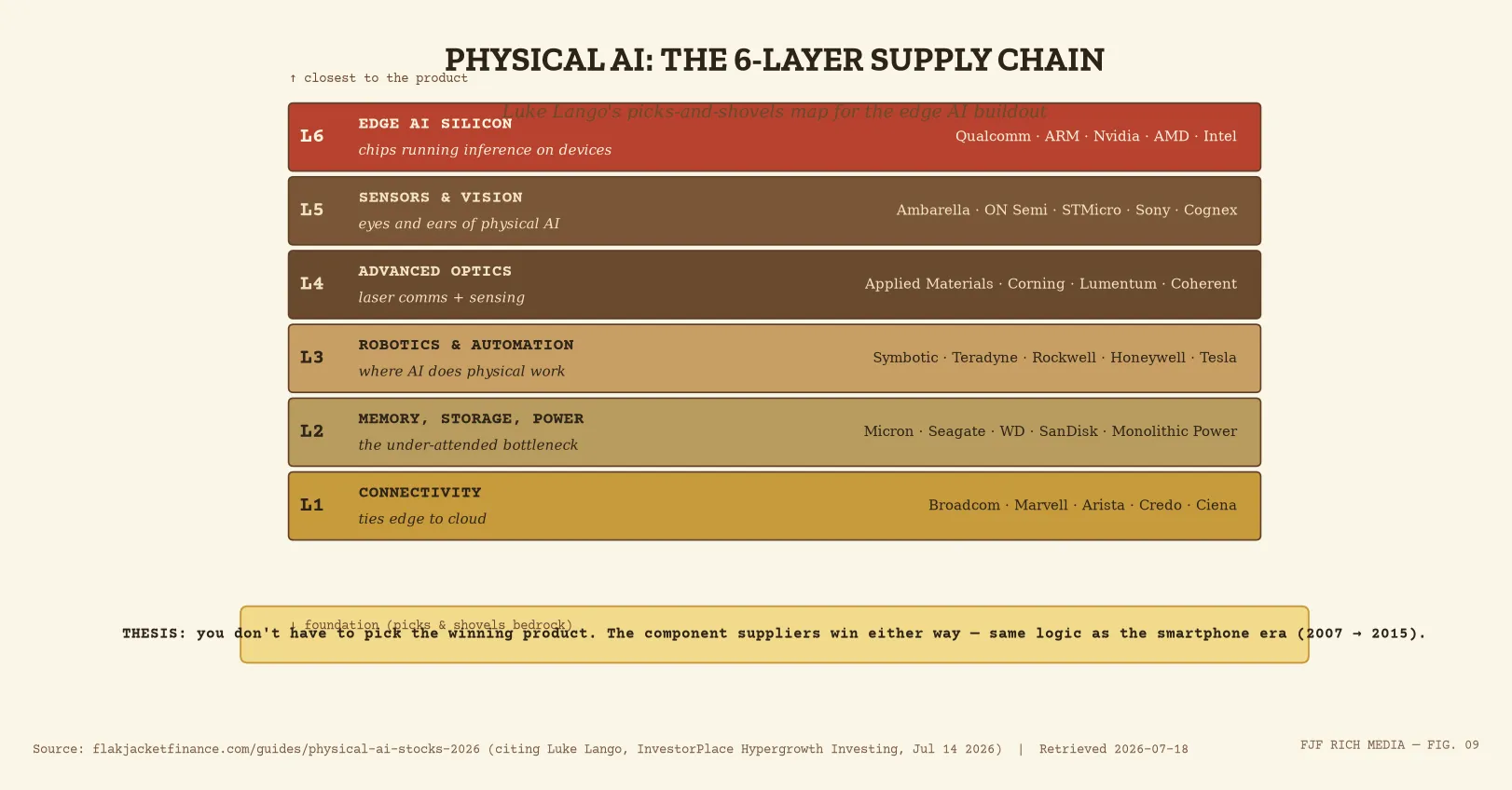
Lango mapped the Physical AI supply chain into six layers. Each layer is a category of companies that build the components physical AI systems need. The logic is picks-and-shovels: the companies selling the infrastructure to the companies building the products.
Edge AI Silicon — the chips that run inference on devices. Qualcomm, ARM Holdings, Nvidia, AMD, and Intel are designing processors that can run AI models at low power, where the competition is about efficiency over brute-force throughput. A chip that runs a vision model on 5 watts instead of 15 watts wins in a wearable.
Sensors and Machine Vision — the eyes and ears of physical AI. Ambarella, ON Semiconductor, Sony, and Cognex build the camera modules, lidar sensors, and vision processors that let machines perceive their environment. Every robot, drone, and autonomous vehicle needs this layer.
Advanced Optics — the technology that moves light. Applied Materials, Corning, Lumentum, and Coherent are the companies behind it, and optics matter because physical AI systems increasingly use laser-based communication and sensing. The same companies that built the fiber-optic backbone for the internet are building the optical links for physical AI.
Robotics and Industrial Automation — the machines themselves. Symbotic, Teradyne, Rockwell Automation, Honeywell, and Tesla operate the layer where the AI actually does physical work: factory automation, warehouse robotics, autonomous systems. The thesis here is that labor scarcity and cost pressure are driving adoption faster than most investors expect.
Memory, Storage, and Power — the components that store data and keep the lights on. Micron, Seagate, Western Digital, SanDisk, Monolithic Power, Analog Devices, and Texas Instruments cover a layer where memory is the bottleneck that gets less attention than chips but is equally critical. Edge devices need fast, low-power memory to run inference locally, and power management chips determine how efficiently a device uses its battery budget.
Connectivity and Infrastructure — the networking that ties everything together. Broadcom, Marvell, Arista Networks, Credo, Ciena, and Corning handle the communication, and the shift from cloud to edge changes the pattern rather than eliminating the need for networking. Edge devices need high-bandwidth, low-latency connections to sync with each other and with cloud-based training systems.
Why the Supply Chain Approach Works
The picks-and-shovels analogy gets used too often in tech investing. In this case, it is accurate. The companies building the physical AI products, Tesla with Optimus, the startups building humanoid robots, the automakers running autonomous fleets, are spending heavily on components. They are buying chips, sensors, memory, optics, and networking gear from the companies in the six pillars above.
The supply chain approach works because it does not require you to pick the winning product company. If Tesla’s Optimus succeeds, the component suppliers win. If a startup’s humanoid robot succeeds, the same component suppliers win. The demand flows through the same bottleneck regardless of whose name is on the final product.
This is the same logic that worked during the smartphone era. You did not need to pick between Apple and Samsung to profit from the buildout. The companies selling displays, memory, sensors, and RF chips to both of them captured the spending either way.
Where This Connects
Lango’s Physical AI thesis layers on top of his earlier frameworks. The Genesis Mission, the government AI infrastructure buildout, deploys capital into the cloud and data center layer. The AI toll roads thesis, his July 2026 framework, covers the infrastructure stack that agentic AI workloads will tax. Physical AI is the third layer: the edge.
The three theses describe different phases of the same buildout. Government money seeds the cloud layer. Agentic AI workloads strain the infrastructure layer. Physical AI pulls the compute out of the cloud and onto devices. The companies that supply components across all three layers are the ones positioned to benefit from the full cycle.
The catalyst for the edge layer is cost. Edge AI silicon is getting cheaper and more efficient. Sensors are getting smaller. Memory is getting faster at lower power. The physics of running AI on a 40-watt device are becoming solvable. When the economics cross the threshold where physical AI products are commercially viable, the supply chain that Lango mapped is where the spending lands.
The Historical Parallel
The smartphone supply chain took roughly a decade to mature. The first iPhone shipped in 2007. By 2015, the component suppliers were generating billions in revenue from the category. The companies that positioned early, before the volume arrived, captured the largest gains.
Physical AI is at the stage the smartphone was in 2007. The products exist, the supply chain is forming, and the volume has not arrived yet. Lango’s framework is a map of where the spending will flow when it does.
The risk is timing. Hardware cycles do not follow software adoption curves. A chatbot can reach 100 million users in two months. A robot has to be manufactured, tested, certified, and shipped. The physical AI supply chain will build out slower than the cloud AI buildout, and the companies in it will face the cyclicality of hardware demand.
Lango published this framework in a market where AI infrastructure stocks are pulling back. His July 14 article on the AI selloff argued the pullback is a setup, and late July earnings from hyperscalers will confirm capex plans. The Physical AI thesis extends that argument: the spending that pulls AI out of the cloud is the next leg, and the supply chain for that leg is being built right now.