Three AI companies. One IPO window. A trillion dollars in new public market value.
Anthropic, OpenAI, and xAI are racing to the public markets in what could be the most significant cluster of technology IPOs since the dot-com era. SpaceX already went public in June. Anthropic filed its confidential S-1 on June 1. OpenAI followed a week later. All three are in play.
The question everyone’s asking: which one wins?
Trick question. The winner isn’t the one that IPOs first. It’s the one with the best fundamentals five years after going public. History has a lot to say about that.
The three contenders
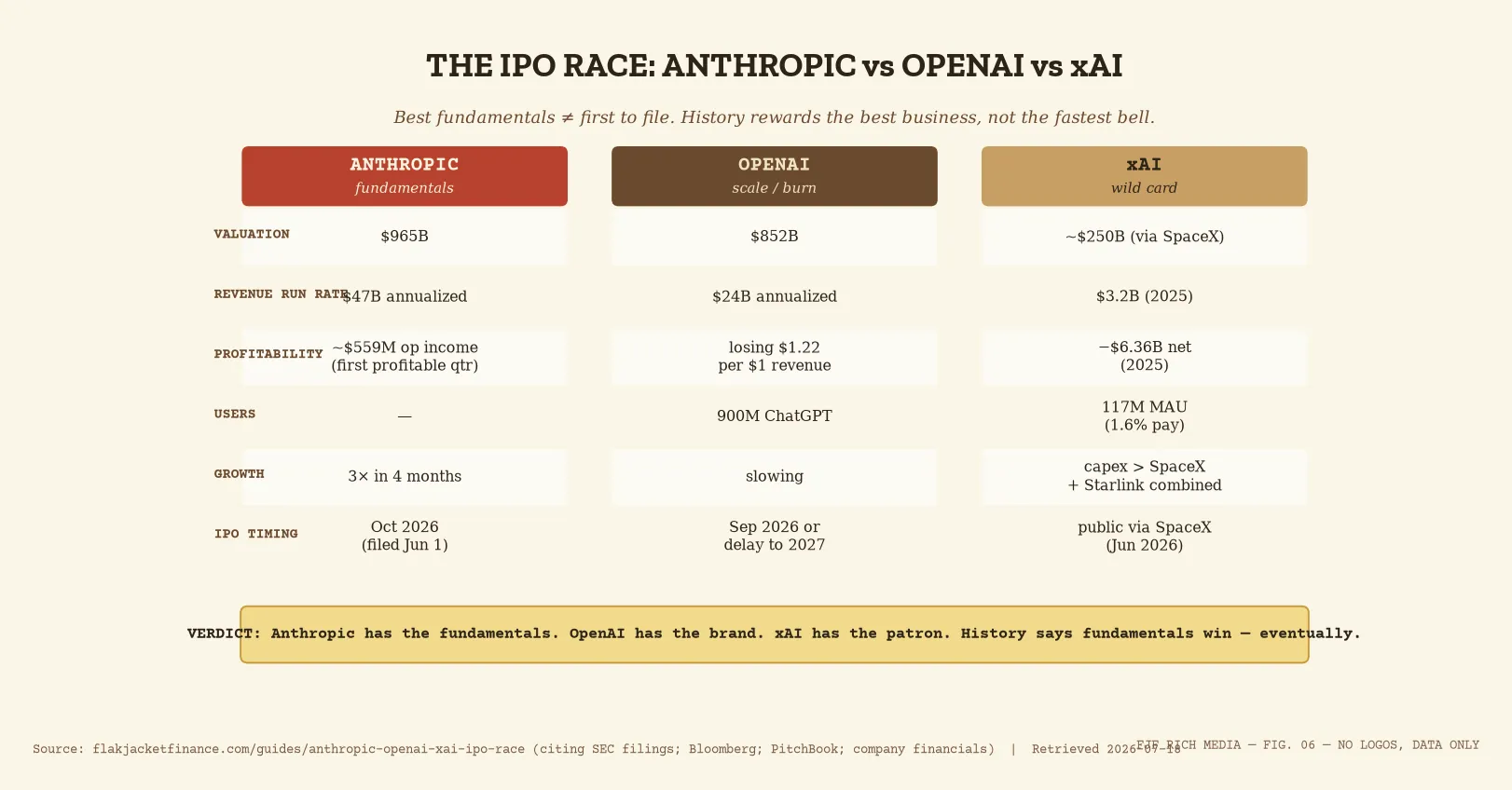
Anthropic, behind the Claude model family, is the IPO frontrunner. The anthropic ipo narrative is the strongest of the three: it filed its confidential S-1 with the SEC on June 1, 2026, four days after closing a $65 billion Series H round at a $965 billion valuation — vaulting past OpenAI in private market value for the first time. Goldman Sachs, Morgan Stanley, and JPMorgan Chase are leading the underwriting. Investor meetings are being scheduled. Bloomberg reports a potential October 2026 debut.
The numbers are staggering. Anthropic’s annualized revenue run rate crossed $47 billion in May, up from $14 billion in February — a more than threefold jump in under four months. Projected Q2 2026 revenue is $10.9 billion. And critically, Anthropic is on pace for its first profitable quarter, with roughly $559 million in operating income. That’s the dividing line between narrative and reality in this race.
OpenAI, the ChatGPT creator, filed its own confidential S-1 on May 22, 2026, at an $852 billion valuation. The numbers are bigger in absolute terms — $2 billion in monthly gross revenue, $20 billion in 2025 revenue — but the direction is less encouraging. OpenAI lost roughly $1.22 per dollar of revenue in Q1 2026. It’s still burning through cash. The company spent $34 billion in 2025, including $19 billion on R&D and $6 billion on sales and marketing.
CEO Sam Altman is reportedly demanding a $1 trillion minimum valuation for the IPO. His advisors are telling him to either wait until 2027 or accept a lower price. Altman called anything below a trillion a “nonstarter.” The NYT reported in late June that OpenAI is leaning toward delaying to 2027. That’s a meaningful signal. If you’re the first mover in AI with 900 million ChatGPT users and you’re hesitating, something is off.
xAI is the wild card. Elon Musk’s AI company, creator of the Grok model, was acquired by SpaceX in February 2026 in an all-stock deal valuing xAI at roughly $250 billion. SpaceX’s June IPO revealed the first-ever public financials for an AI frontier model company. The picture is ugly. xAI lost $6.36 billion on $3.2 billion in revenue in 2025. It spent $12.7 billion in capex — more than SpaceX spent on Starlink and its rocket launch service combined. In Q1 2026, xAI had $818 million in revenue against a $2.47 billion operating loss.
Grok has 117 million monthly active users. Only 1.9 million of them pay for access. That’s a 1.6% conversion rate. The infrastructure spend is existential. xAI’s financials are, in PitchBook’s words, “reckless.”
But xAI has one thing neither Anthropic nor OpenAI has: a patron with effectively unlimited capital. The SpaceX merger granted xAI access to SpaceX’s balance sheet and a $20 billion bridge loan that refinanced xAI’s expensive debt. And there’s the Colossus connection — xAI’s South Memphis data center is powering Anthropic’s compute under a reported deal. The same company competing with Anthropic is also its compute provider. That’s a relationship worth watching.
The fundamentals: who has the best numbers?
Revenue is the obvious starting point. OpenAI leads in absolute terms with $2 billion monthly gross revenue. Anthropic was at roughly $3.6 billion monthly as of Q2 run rate, but growing at a pace that OpenAI can’t match. Anthropic doubled revenue from Q1 to Q2. OpenAI’s growth rate has slowed as ChatGPT user growth stalls at 900 million.
Valuation tells a similar story. Anthropic’s $965 billion valuation is 22x annualized revenue at $47 billion run rate. OpenAI’s $852 billion works out to roughly 35x its $2 billion monthly run rate. On a pure multiple basis, OpenAI is priced for perfection. Anthropic has room to grow into its number.
Profitability is where the gap widens. Anthropic is on pace for its first profitable quarter. OpenAI is not. xAI is losing more than $2 billion per quarter. The interest rate environment matters here. In a low-rate world, investors tolerate massive cash burn for growth. At current rates, the market rewards discipline. Anthropic has it. OpenAI and xAI don’t.
The gross margin question is the elephant in the room. PitchBook’s Harrison Rolfes called it “the number that determines everything” — and nobody outside Anthropic has seen it. If Anthropic’s gross margins are comparable to SaaS companies (70-80%), the $965 billion valuation is defensible. If they’re closer to 50%, the bull case collapses. The public S-1 will answer this.
Does first-mover advantage apply to IPOs?
The conventional wisdom is that the first company to IPO wins. It captures the narrative, sets the valuation benchmark, and sucks up all the investor attention. The second company has to explain why it’s different.
History says otherwise.
In the late 1990s, Google was the best search engine. It was not the first to IPO. Yahoo went public in April 1996 at a $38 million valuation. Ask Jeeves went public in 1999. Google didn’t IPO until August 2004 — eight years after Yahoo. The first mover didn’t win. The best product did.
Facebook vs. MySpace is the same story. MySpace went public first. Facebook waited. The company with the better product, the better data, and the better monetization won by a landslide.
Anthropic being the first to file an S-1 doesn’t guarantee it will be the best public company. But the historical pattern supports the company with the strongest fundamentals — not the one that goes public first. In this race, Anthropic has the fundamentals.
The strategic positioning
Anthropic’s edge is its safety focus and enterprise adoption. The Claude model family has become the default choice for regulated industries — finance, healthcare, legal — where OpenAI’s brand carries baggage. Enterprise revenue is growing faster than consumer. That’s a higher-quality revenue stream with better retention and higher margins.
OpenAI’s edge is brand recognition and scale. ChatGPT is a household name. Nine hundred million users is a moat. The question is whether OpenAI can monetize those users before they drift to free alternatives. The consumer-to-enterprise conversion is happening — enterprise now makes up 40% of OpenAI’s revenue — but it’s happening slower than investors expected.
xAI’s edge is vertical integration. Grok runs on X’s data. X runs on xAI’s models. SpaceX runs the compute. The combined entity is worth $1.25 trillion on paper. But the financials suggest the sum isn’t adding up yet. xAI is burning through cash faster than any other frontier lab, and its paying user base is tiny. The upside is Musk’s ability to deploy capital without regard for quarterly earnings. The downside is that the model is unproven at scale.
The wild card: the IPO window itself
The fall 2026 IPO window is crowded. SpaceX’s June IPO, Anthropic’s potential October listing, OpenAI’s possible September or delayed 2027 debut. Combined, these three companies represent over $200 billion in new public market value. That’s concentration risk.
If Anthropic IPOs first and trades well, it opens the door for OpenAI. If Anthropic IPOs and the market punishes the valuation, it could close the window for everyone. The first mover in this race doesn’t just set the benchmark — it defines the market’s appetite for the entire AI sector.
The smart money is on Anthropic going public in October 2026 at a valuation that gives the market room to bid up. OpenAI faces a harder choice: price at $1 trillion and risk a weak debut, or price lower and admit Altman’s nonstarter was bluster.
Where this leaves us
Anthropic has the best fundamentals: the fastest growth, the earliest path to profitability, the highest-quality revenue. OpenAI has the biggest brand and the most users, but the financials don’t support the trillion-dollar ask. xAI has the most powerful patron and the most alarming burn rate.
The IPO race isn’t about who files first. It’s about who builds the best business. On that metric, Anthropic is the clear frontrunner. The public S-1 will either validate that thesis or reveal the cracks. Either way, the answer arrives before the end of the year.
The last time three companies of this size hit the public markets in the same window, the best one wasn’t the first to ring the bell. It was the one that figured out how to monetize its technology at scale before the competition did. That’s the same test Anthropic faces now.