The AI boom has an electricity problem.
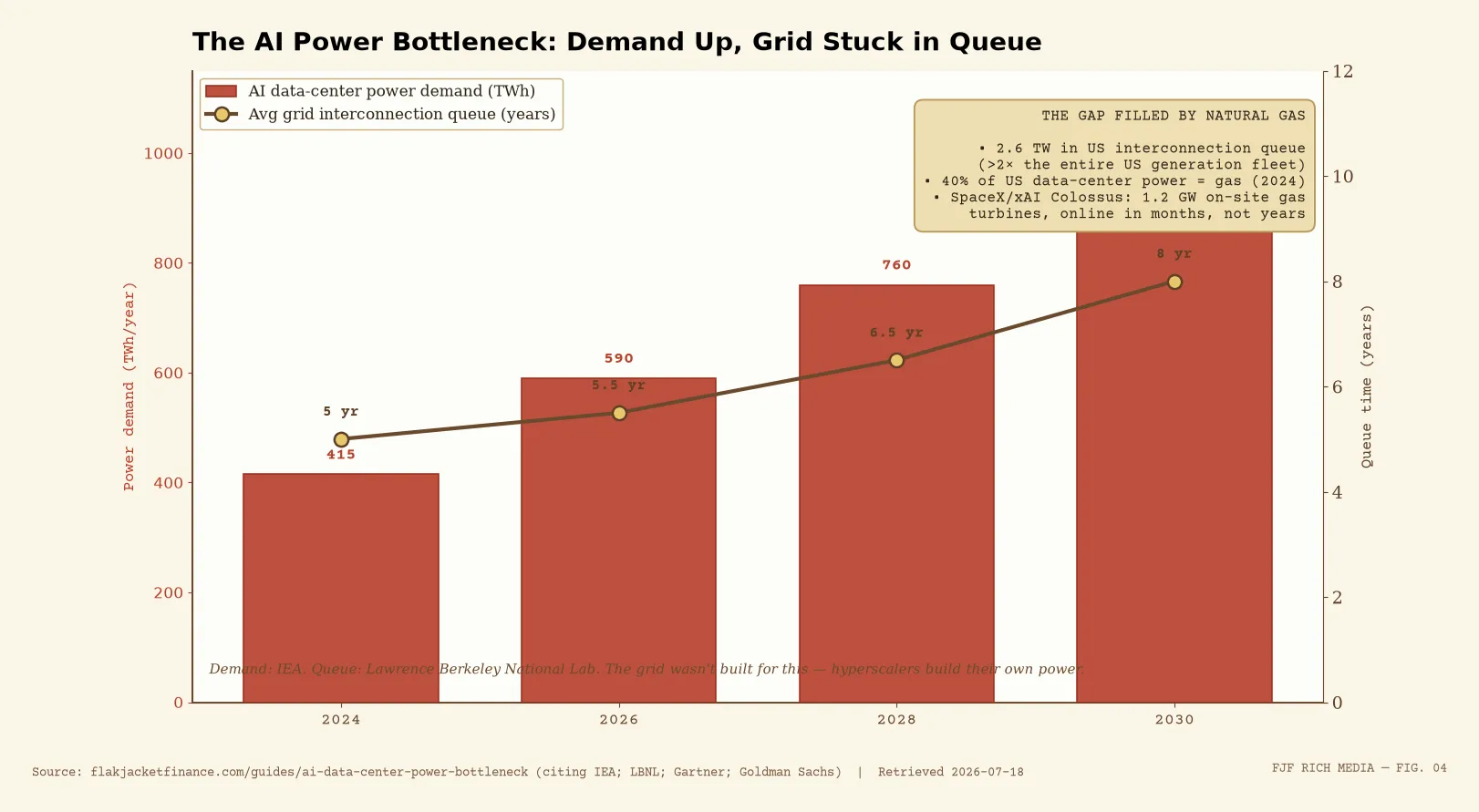
AI data centers consumed roughly 415 TWh of electricity in 2024, according to the International Energy Agency. By 2030, that number hits 945 TWh — more than the total electricity consumption of Canada and Germany combined. The grid was never built for this. Waiting for utilities to catch up means waiting five to ten years in interconnection queues. Hyperscalers aren’t waiting. They’re building their own power plants.
This is the AI data center power bottleneck — and companies like Fermi America exist because of it.
The math doesn’t pencil on the grid
Gartner projects global data center power demand will hit 132 GW in 2026, up 27% year over year. IDC puts AI infrastructure spending at $487 billion in 2026, crossing $1 trillion by 2029. And by 2027, AI servers will consume more electricity than all non-AI servers combined.
The problem: utility-scale interconnection queues — the process to get new power onto the grid — run five to ten years. Northern Virginia (Data Center Alley) is already rationing power. Dominion Energy told the PJM Interconnection that new data center load in its territory could hit 25 GW by 2035 — roughly the output of 25 large nuclear plants. Dominion paused new grid connections in parts of Loudoun County in 2023 and hasn’t fully reopened them.
Dallas-Fort Worth is bumping against transformer availability. Oncor Electric Delivery, the local utility, reported data center interconnection requests exceeding 40 GW in 2024 — more than twice its current peak load. Dublin has a moratorium on new data center connections, and the entire Republic of Ireland is now a test case for what happens when data center load hits 30% of national electricity demand.
Even established utility territories can’t keep up. The queue for new generation and storage projects seeking interconnection in the U.S. hit 2.6 TW by the end of 2024, according to Lawrence Berkeley National Lab. That’s more than double the entire existing U.S. generation fleet. Average queue time: five years and climbing.
The bottleneck isn’t compute. It’s electrons.
Natural gas is the answer right now
Solar and wind are cheap but they don’t run 24/7. Batteries can buffer but not sustain at data center scale — a 1 GW data center with six hours of battery backup needs 6 GWh of storage, which costs roughly $2 billion at current pack prices and eats 10+ acres. Small modular reactors are five to ten years away from meaningful deployment. Fusion is a decade-plus out. The only technology that can add gigawatt-scale power in months — not years — is natural gas turbines.
This isn’t hypothetical. SpaceX and xAI built the Colossus cluster in Memphis running 46 natural gas turbines. Total permitted capacity: 1.2 GW. That cluster came online faster than any comparable data center in history because they didn’t wait for the grid. The turbines are simple-cycle aeroderivative units — essentially jet engines mounted on skids — that can ramp from cold start to full load in under ten minutes. No cooling towers. No transmission lines. Just gas pipe in, electrons out, compute running.
Gas turbines are proven, modular, and fast to deploy. A 300 MW gas plant can be permitted and built in 18 to 24 months in favorable jurisdictions — versus 5 to 10 years for a comparable grid interconnection. They’re dispatchable: when AI training needs full power at 3 AM, gas delivers. They pair naturally with data center waste heat recovery and on-site water treatment.
The trade-off is carbon. Natural gas isn’t zero-emission. But every hyperscaler has made the calculation: better to burn gas and train today than wait for a carbon-free grid that doesn’t exist yet.
Fermi America: built for the bottleneck
Fermi America is one of the companies purpose-built for this moment. Their flagship project is the HyperGrid campus in the Texas Panhandle — a region with available land, existing gas infrastructure, and regulatory speed. Jim Litman, founder of Audible and an experienced builder in capital-intensive infrastructure, serves as senior adviser.
Fermi America’s model is straightforward: colocate AI compute with natural gas generation. No grid dependency. No interconnection queue. No waiting. The Texas Panhandle isn’t a random pick — it sits on the Permian Basin’s gas output, giving Fermi America direct access to fuel without pipeline bottlenecks. The region’s geology also supports carbon sequestration, which gives the project a lower-carbon pathway as carbon capture economics improve.
The economics work because the alternative — waiting on the grid — kills AI timelines. If your competitor trains GPT-6 while you’re still negotiating utility tariffs, you lose. The premium for on-site gas generation compared to wholesale grid power is typically $15-30/MWh, or roughly 1-2% of the total cost of operating an AI cluster. That premium is insurance against a multi-year delay.
Fermi America isn’t alone in this play. Across the U.S., developers filed interconnection requests for more than 81 GW of new gas-fired generation in 2024, much of it tagged for data center colocation. Companies like Scale Microgrids, Competitive Power Ventures, and Pine Gate Renewables are all building dedicated gas generation for AI load. The market is voting with capital.
The cost of waiting
Every hyperscaler and AI lab is facing the same choice: pay a premium for on-site power or accept a multi-year delay. The premium is real — natural gas generation at a data center site costs more per MWh than grid power in most markets. But the cost of delay is infinite if your competitor ships the next capability frontier first.
That’s why the buildout is accelerating. Goldman Sachs estimates U.S. data center power demand will grow 15% annually through 2030. The Edison Electric Institute says data center load requests to U.S. utilities tripled in 2024 alone. Utilities aren’t being lazy — they’re building distribution transformers on 18-month lead times and large transmission projects on decade timelines. The transformer shortage alone is a multi-billion dollar bottleneck: U.S. utilities are waiting 18 to 24 months for large power transformers, and global supplier capacity is maxed out.
The market isn’t waiting for transmission. It’s moving generation to the load. That means gas turbines on site, behind the meter, connected directly to the data center’s switchgear. No utility middleman. No transmission loss. No queue. It’s the same logic that drove edge computing — take the resource to where it’s needed, not the other way around.
The long view: gas as bridge, not destination
Natural gas isn’t the end state. It’s the bridge.
Fermi America’s HyperGrid sites are designed for eventual carbon capture, hydrogen blending, or conversion to SMR heat. The gas turbines they’re installing today can burn hydrogen blends tomorrow, up to 30% hydrogen by volume without modification, and higher with combustor upgrades. The sites themselves — land, interconnection rights, water, fiber connectivity — are the scarce asset. Gas generation gets them cash-flow positive now while the long-term energy transition plays out.
The IEA’s 945 TWh projection for 2030 assumes current policy trends hold. If AI continues scaling at its current rate, that number could be conservative by 20-30%. Every major hyperscaler — Microsoft, Google, Amazon, Meta — has announced data center expansions that depend on power availability. Microsoft signed a deal to restart Three Mile Island. Amazon bought a nuclear-powered data center campus from Talen Energy. Google is partnering with Kairos Power on small modular reactors. Meta just announced a $10 billion AI data center in Louisiana with utility Entergy.
These are all hedges on future carbon-free power. But none of them meaningfully contribute before 2030. The next five years belong to natural gas. Companies like Fermi America are the vehicle.
What this means for AI progress
The power bottleneck is the most underappreciated constraint on AI timelines. Compute gets cheaper per FLOP, but power delivery gets harder per megawatt. The industry is trading one constraint for another. Moore’s Law drove compute costs down by roughly half every two years for decades. Data center power costs are heading in the opposite direction — sites that paid $30-40/MWh five years ago now negotiate $60-80/MWh, and on-site gas generation can push higher still.
The companies that solve power will win the next phase of AI. That means firms that can identify sites with gas, water, and fiber access. Navigate permitting and regulatory complexity at speed. Close construction financing at scale. Operate gas turbines as a core competency, not an afterthought. Fermi America checks all three boxes. The question is whether they can execute faster than the hyperscalers who are also learning this game.
The AI data center power problem isn’t a technology problem — it’s an infrastructure and regulatory problem. Infrastructure problems get solved with concrete, turbines, and pipelines, not software patches. The companies that treat power acquisition and on-site generation as a first-class engineering challenge — on par with model architecture and training efficiency — will be the ones that ship the next generation of AI.
The grid wasn’t designed for hyper-scale AI. Smart companies are building their own grid. That’s not a contingency plan. That’s the plan.