The question sounds like a trap. Can AI predict stock prices? The answer is yes, no, and it depends — which is the kind of answer that sells newsletters and confuses everyone else.
The research is real. The results are impressive. The limitations are brutal. Let’s walk through what the academic literature actually says, what approaches exist, what works, and what doesn’t.
The consensus: short-term yes, long-term barely
The honest answer is that AI can predict short-term directional movement — next-day, next-week, next-month — with statistical significance that embarrasses the efficient market hypothesis. The evidence is piling up too fast to ignore.
The catch is that the edge shrinks or disappears after trading costs, especially for strategies that trade frequently. The market is an adversarial system. Every time someone publishes a paper showing a new anomaly, hedge funds reverse-engineer the signal and trade against it until the edge normalizes. The market is not stationary. It learns.
The difference between backtest and reality is the difference between shooting free throws in an empty gym and shooting with a defender in your face. The gym stats are great. The game stats are what matter.
What approaches exist
The field has fragmented into four distinct approaches, each with different strengths and failure modes.
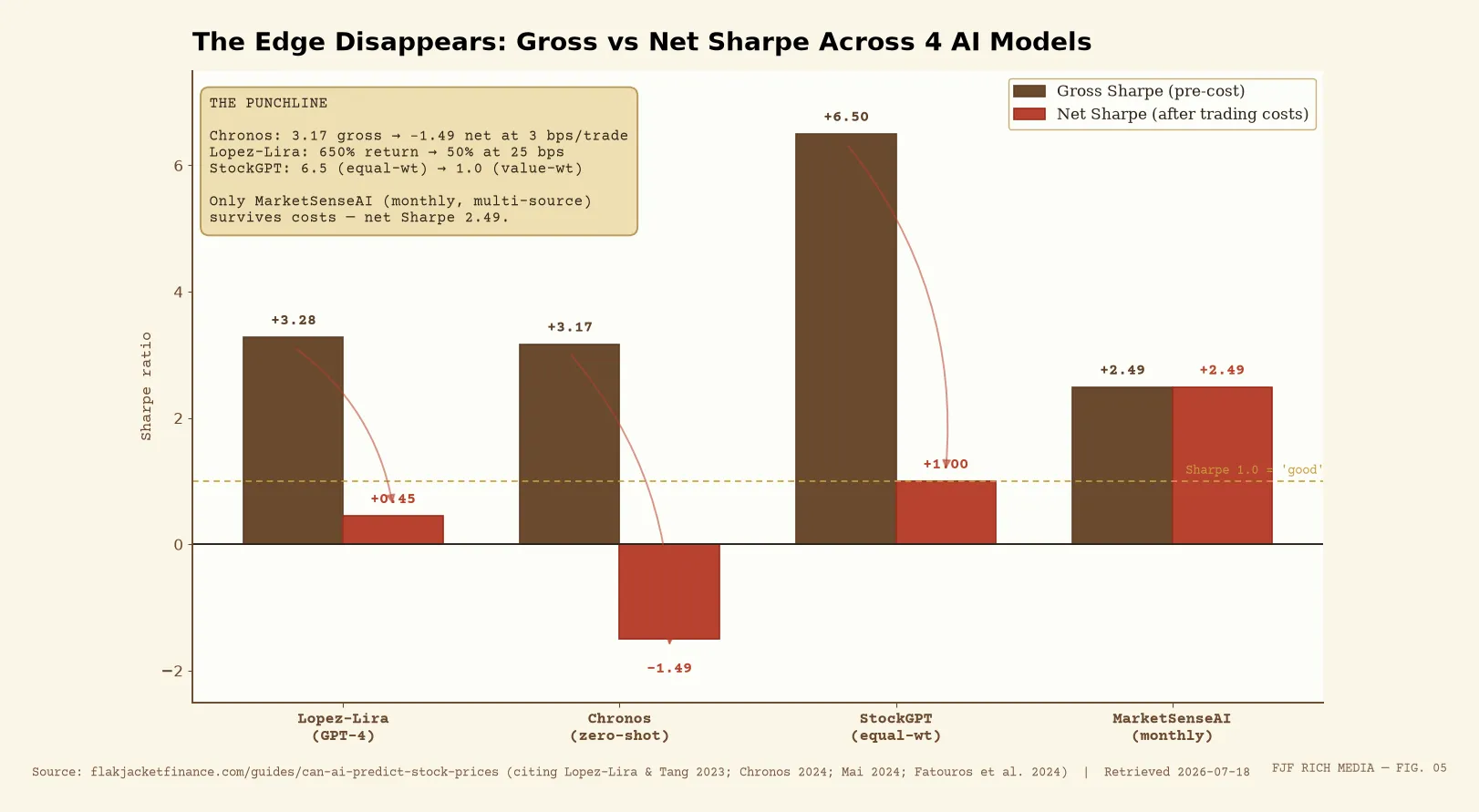
LLM-based prediction. The simplest approach uses a large language model — usually ChatGPT or GPT-4 — to evaluate news headlines and assign a sentiment score. Lopez-Lira and Tang (2023) ran this experiment. They fed ChatGPT headlines and asked whether the news was good, bad, or neutral for the stock price. A long-short portfolio based on GPT-4’s scores earned a Sharpe ratio of 3.28 and a cumulative return of over 650% from October 2021 to December 2023. The strategy was simple: buy stocks with positive ChatGPT scores at market open, sell them at close. Same-day trading, zero holding period risk.
The catch: those numbers are pre-transaction costs. At 10 basis points per trade, the cumulative return drops to 350%. At 25 basis points, it falls to 50%. The edge exists, but it’s fragile.
Transformer-based time-series models. The Chronos paper (2024) took a different approach. The researchers used a pretrained time-series foundation model — zero-shot, with no financial training data — to predict single-stock returns. The results were astonishing. The model achieved a gross Sharpe ratio of 3.17 on a PCA-based long-short portfolio over 15 years. The t-statistic was 12.27. By any statistical standard, that’s not noise.
The catch here is sharper. When the researchers factored in trading costs of just 3 basis points per trade — the standard market impact for small orders, plus brokerage fees — the net Sharpe ratio turned negative. The gross edge was real. The net edge was gone.
The fine-tuned version reached a gross Sharpe of 4.21 with volatility-adjusted weights. Same cost problem.
Pure price-pattern models. StockGPT (Mai, 2024) is the most focused example. It’s a lightweight GPT-style transformer with four attention blocks and about one million parameters, trained on 50 million daily U.S. stock returns from 1926 to 2000. The model was tested out-of-sample on data from 2001 to 2023 — 23 years it had never seen.
The daily-rebalanced equal-weighted long-short portfolio earned an annual return of 119% with a Sharpe ratio of 6.5. The model spans momentum and short-term reversal factors completely. It generates a significant alpha of 16% annually against all 11 major stock factors combined. The paper calls this a “novel AI pricing effect.”
The caveat is the same one. Daily rebalancing means daily trading costs. The value-weighted version — which is more realistic for institutional capital — earns a Sharpe of roughly 1.0 and an annual return of 27%. Still good, but not the magical 6.5.
Multi-source reasoning frameworks. MarketSenseAI (Fatouros et al., 2024) is the most ambitious. It’s a GPT-4-based framework that analyzes news, fundamentals, price data, and macroeconomic reports for each stock, then issues buy, hold, or sell signals with step-by-step reasoning. Over 15 months on the S&P 100, the system delivered excess alpha of 10-30%, achieving cumulative returns of up to 72% with risk profiles comparable to the market.
MarketSenseAI 2.0 extended the test to two years and found cumulative returns of 125.9% versus the S&P 100’s 73.5%. The alpha held at 8-18% after transaction costs. The win rate was 77%.
This is the most credible evidence that AI stock selection can work in practice, not just in backtests. The framework processes the same inputs a human analyst would, and it produces explanations you can audit. That matters.
What works and what doesn’t
The evidence supports a clear pattern.
Short-term momentum works. AI can detect subtle directional signals in price data, news flow, and cross-asset relationships that human traders miss. The StockGPT results show that a transformer trained on 20th-century data can predict 21st-century returns. The Chronos results show that a model trained on non-financial data can identify stock market inefficiencies. The signal is real.
Long-term fundamental prediction is hard. The MarketSenseAI results are the best evidence for multi-month stock selection, but the test window was a bull market. The framework’s own analysis shows that news and price dynamics drive most of the signal, while fundamentals and macro data contribute less. The long game is still the hard game.
Directional accuracy is not target accuracy. Most AI models can tell you whether a stock will go up or down better than a coin flip. That’s directional accuracy. But telling you how much it will move, and on what day, is a much harder problem. An-E, the TradeSmith ensemble engine, reports 57.53% directional accuracy and 60.30% target accuracy across 2,300 stocks. The numbers are honest and the gap between them is instructive. Direction is the easier call. Precision is the harder one.
Edge disappears in the cost layer. The single most consistent finding across every paper is that trading costs erase most of the machine learning advantage. The Chronos paper showed a Sharpe of 3.17 drop to -1.49 after 3 basis points per trade. The Lopez-Lira paper showed a 650% return drop to 50% after 25 basis points. The StockGPT paper’s value-weighted portfolio is more realistic than the equal-weighted one. The market is not efficient in the academic sense. It is efficient enough to charge a toll on every edge.
Why ensemble models are more robust
The academic literature is converging on a single architectural insight: no single model is reliable enough for live trading. The market regime shifts — trending, mean-reverting, volatile, quiet — and different models perform best in different regimes.
This is why ensemble methods, also called stacking or meta-learning, outperform single models. The idea is simple. Instead of betting on one prediction, you combine predictions from multiple models — a trend-following model, a volatility model, a news-sentiment model, a mean-reversion model — and let a meta-learner weight them dynamically based on current market conditions.
An-E is built on this principle. Two AI models work in parallel. One tracks longer-term trend patterns. The other handles short-term noise. Together, they produce a forecast that’s more stable than either alone. The approach mirrors the academic literature on stacking ensembles, which has shown that combining heterogeneous models — statistical, tree-based, and deep learning — can achieve R-squared values above 0.97 for price-range forecasting on major indices.
The advantage is real. A single model can be wrong in predictable ways. An ensemble can be wrong in different directions, and the meta-learner discounts the models currently underperforming. The result is a system more robust to regime changes and less likely to blow up on a single bad assumption.
The fundamental problem
The market is adversarial. Every time a profitable AI signal is discovered, more capital chases the same trade. The edge decays. The signal becomes the noise. The market is not a stationary distribution like image recognition. It’s a game where the rules change because the players change.
The Chronos paper found this explicitly. The gross Sharpe ratio declined over the 15-year sample period. The strongest signals were in the pre-2008 data. After the financial crisis, the market became harder to predict. The pattern is consistent with the literature on market efficiency — the more participants use AI, the harder it becomes for any single AI to outperform.
This is not a reason to dismiss AI stock prediction. It’s a reason to be realistic about what it can deliver. The returns are real, but they’re compressed. The edge exists, but it’s shrinking. The best use of AI in trading is not finding the perfect strategy and riding it forever. It’s building systems that adapt faster than the market can adapt to them.
What the numbers mean
The Sharpe ratio is the most common metric. A Sharpe of 1 is good. A Sharpe of 2 is excellent. A Sharpe of 3 is extraordinary. The papers here report Sharps of 3 to 6.5. Those numbers are real, but require a careful reading.
Gross Sharpe ratios exclude trading costs. Net Sharpe ratios include them. The gap between gross and net is the real story. The Chronos model’s gross Sharpe of 3.17 collapsed to negative after 3 basis points. The Lopez-Lira GPT-4 strategy’s gross Sharpe of 3.28 would be materially lower after same-day trading costs. The StockGPT equal-weighted Sharpe of 6.5 is a daily rebalancing strategy that would be expensive to implement.
MarketSenseAI is the exception. Its Sharpe ratio of 2.49 (after costs) and 10-30% alpha are the most actionable numbers in the literature. The framework trades monthly, not daily. The costs are lower. The signal is richer.
The pattern suggests a principle: the more data sources a model uses, the more durable the edge. Pure price-pattern models decay fast. Models that incorporate news, fundamentals, and macro context have a wider moat.
The direction of travel
The field is moving toward larger, more integrated models. MarketSenseAI 2.0 added SEC filings, earnings calls, and institutional reports. The next generation will incorporate alternative data — satellite imagery, supply chain data, credit card transactions. The model that synthesizes the most diverse information will have the most durable advantage.
The academic consensus is that AI can predict stock prices in the short term. The debate is about whether the edge survives costs, scale, and competition. The evidence says the edge is real but compressed. The best systems — ensemble models like An-E, multi-source frameworks like MarketSenseAI — are pushing the boundary.
The honest answer is the most interesting one. AI can predict stock prices, but not the way the hype suggests. It’s not a crystal ball. It’s a statistical edge that must be engineered, maintained, and defended against a market that learns as fast as the AI does. The question is not whether the edge exists. It’s whether you can execute it cheaper and faster than the person on the other side.