Jeff Brown says the next data center boom happens in orbit. The thesis has a regulatory paper trail behind it, an engineering logic behind it, and a marketing number on top of it. The trust check is whether those three layers hold together.
The pitch is the Orbital AI campaign out of Brownstone Research. Brown argues that SpaceX will deploy roughly one million satellites carrying compute capacity into low-earth orbit, that the radiation environment forces a specialized chip supplier into the bottleneck, and that the supplier is the investment. The question here is narrower: when you strip the presentation down to what is verifiable, what is left. The SpaceX IPO Musk thesis guide maps the broader SpaceX infrastructure buildout the orbital data center thesis depends on.
The thesis stated plainly
Terrestrial data centers run into three walls at once. Electricity, water, and land. A single large facility can draw 100 megawatts, enough to power roughly 80,000 homes. Cooling water consumption doubles every 36 months at current growth rates. Permitting on new construction runs into multi-year delays because nobody wants a data center campus next to their town.
Orbit removes all three constraints. Solar power in low-earth orbit is continuous. Cooling is passive, because the near-absolute-zero vacuum of space is the ultimate heat sink. There is no land-use conflict because there is no land. The argument is that once launch cost falls below a specific threshold, putting compute in orbit becomes cheaper than building it on the ground.
That is the thesis. The question is whether the infrastructure exists to support it and whether the economics close.
The FCC filing as primary source
The piece of evidence that separates this from speculation is a filing with the Federal Communications Commission. SpaceX filed a confidential application describing an orbital data center system, a constellation of satellites in low-earth orbit, each carrying roughly 150 kilowatts of compute capacity, connected by laser interconnects and powered by solar arrays with liquid radiator cooling.
A company does not file with the FCC for a system it does not intend to build. The filing is not a guru claim. It is a regulatory document submitted under penalty of perjury to a federal agency, and it describes the system in engineering detail that matches the physics.
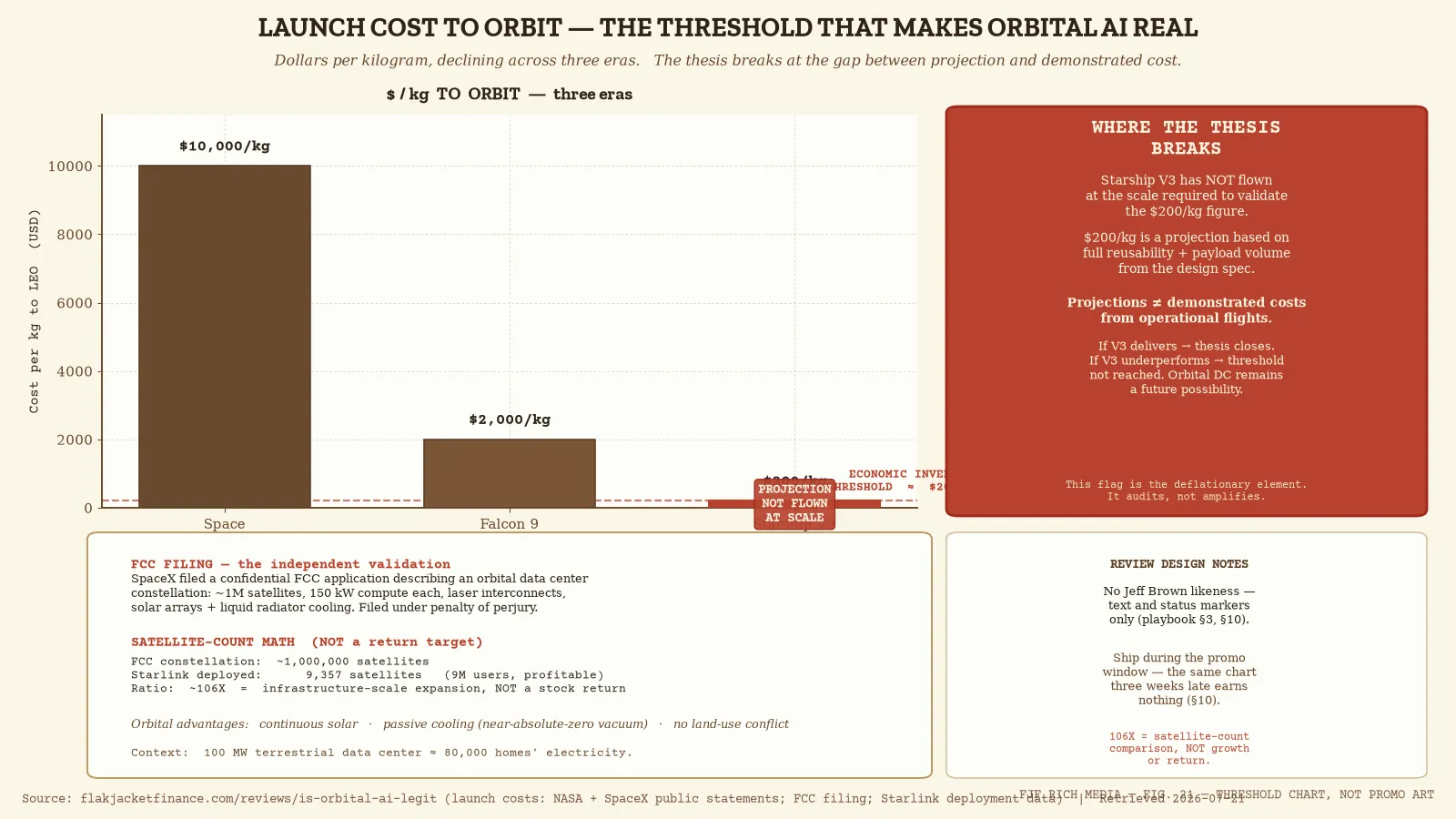
The scale is the part that sounds like marketing until you remember the track record. The filing describes a constellation on the order of one million satellites. Starlink, the proof of concept, already has 9,357 satellites deployed, 9 million users onboarded, and a profitable business running. The orbital data center is the same manufacturing model producing a different product. The FCC filing is the independent validation that the constraint is real, the architecture is real, and the intent is real.
Brown’s engineering background
Background matters when the thesis depends on reading a regulatory filing and knowing whether the engineering inside it is sound. Brown holds a degree in aeronautical and astronautical engineering from Purdue, earned in 1987, and spent roughly two decades inside semiconductor and networking companies, Qualcomm, NXP, and Juniper Networks, much of it based in Tokyo with a front-line view of the Asian chip supply chain.
The orbital data center thesis sits at the intersection of both halves of that resume. The orbital mechanics of a low-earth constellation is aeronautical engineering. The radiation-hardened chip constraint is semiconductor supply chain. When Brown reads the FCC filing and identifies the rad-hard chip as the bottleneck, he is reading a document in a discipline he was trained in and identifying a component constraint in an industry he worked inside.
It makes the analysis substantive, which is the bar a trust check is measuring. The full career arc, including the Nvidia, Bitcoin, and Tesla calls that established his name, is documented in the Near Future Report review. Past performance does not guarantee future results.
The 106X claim
The 106X figure is where the marketing and the substance diverge. The number refers to the expansion in satellite count, roughly one million orbital data center satellites versus Starlink’s current deployed base of around 9,357. That is a count of infrastructure units, not a return on any single investment.
A 106X increase in the satellite count means the market for space-based compute infrastructure would be orders of magnitude larger than the current market for satellite broadband. That is a statement about the size of the buildout. It is not a statement about what any one supplier stock will do, what the timeline will be, or what the risk-adjusted return looks like for an investor buying in today.
The multiplier is real as a measure of scale. It is marketing math as a measure of investment return. The distinction matters because a reader who hears 106X and assumes it maps to a portfolio return is hearing a different claim than the one the number actually makes.
The $200 per kilogram threshold
The economics of orbital compute rest on a single variable: launch cost. During the Space Shuttle era, sending a kilogram to orbit ran roughly $10,000. On the Falcon 9 today, the figure is down to about $2,000 per kilogram. Brown argues that Starship V3, the next-generation fully reusable vehicle SpaceX is developing, will bring that cost to $200 per kilogram.
The gap between $2,000 and $200 is the entire thesis. At $2,000 per kilogram, orbital data centers are an engineering curiosity that cannot compete with terrestrial facilities on cost. At $200 per kilogram, the economics invert, and orbit becomes cheaper than ground for certain classes of compute.
Starship V3 has not flown at the scale required to validate the $200 figure. The number is a projection based on the design’s full reusability and the payload volume the vehicle is built to carry. Projections from engineering specs are not the same as demonstrated costs from operational flights. If Starship V3 delivers, the thesis closes. If the vehicle underperforms, launches less frequently than projected, or costs more to operate than the spec sheet suggests, the threshold is not reached and the orbital data center remains a future possibility rather than a present economics.
Where the Thesis Stands
The Orbital AI thesis has three layers, and they hold up to different degrees of scrutiny. The FCC filing is a real regulatory document describing a real system SpaceX intends to build. The rad-hard chip constraint is a real physics problem that creates a real bottleneck for any company trying to execute on the architecture. The 106X figure is satellite-count math that describes the scale of the buildout, not a return projection. The $200 per kilogram launch cost is a forward projection that has not been demonstrated in operational flight.
The thesis has more substance than the average teaser pitch because it rests on a regulatory filing and an engineering constraint rather than a narrative. The marketing number on top of it, the 106X, is the part that does not survive the translation from infrastructure scale to investment return. Strip the multiplier, keep the filing and the physics, and the case for a radiation-hardened chip supplier to a space-based compute buildout is a real thesis with a real variable attached to it. The variable is whether Starship V3 flies at the cost the design projects.
Jeff Brown’s engineering background gives him the literacy to read the FCC filing and identify the bottleneck correctly. Whether the specific supplier named in the paid report is the right one is a separate question, and one the presentation does not answer. The structural case, independent of any single pick, is what holds up under scrutiny.