Here is the idea.
George Gilder has been doing this for nearly 40 years. He was Reagan’s most frequently quoted living author — a supply-side economist who pivoted in the late 1980s to technology. In 1989, Microcosm argued the semiconductor would define the era. In 2000, Telecosm argued bandwidth would replace processing power as the defining abundance. He coined the term “digerati” in 1992. In the late 1990s, telecom stocks would move on his mention of them — a phenomenon so consistent it got a name: the Gilder Effect. He was earning $100,000 per speech. His company was being groomed for a $200 million public offering.
Then the telecom bubble imploded. Hundreds of Gilder’s favored companies went bust. His newsletter subscribers lost heavily. The Gilder Effect worked in both directions. A 2005 Boston Globe profile described the aftermath: speaking fees collapsed, his ownership stake in The American Spectator was gone, his newsletter was “barely breathing.” He kept writing. The next thesis — Life After Google (2018), Life After Capitalism (2023), and now Ambient AI (2026) — kept coming because the framework is what he sells, not the picks. The framework is identifying the technology shift before the shift is obvious. The picks are the vehicle for expressing the thesis. The framework has been right more often than the picks. That is the Gilder story, and Ambient AI is the latest chapter in it.
Artificial intelligence has lived in the cloud. Massive data centers, rivers of electricity, Nvidia GPUs running trillion-parameter models behind a wall of server racks. That phase built the most valuable companies on earth.
The next phase moves AI onto the device. Onto the phone, the car, the drone, the satellite, the factory sensor. AI that runs locally, on chips that draw watts instead of gigawatts. Gilder calls this “Ambient AI” — intelligence that surrounds you, processes where you are, and does not need to phone home to a data center to think.
The promo runs through Eagle Products under the Gilder’s Moonshots banner. The thesis has three layers: a technology shift from cloud to edge, a programmable chip architecture that enables it, and a small company with the patents, the Pentagon contracts, and the fabrication partnership to be the enabler.
The Shift From Cloud to Edge
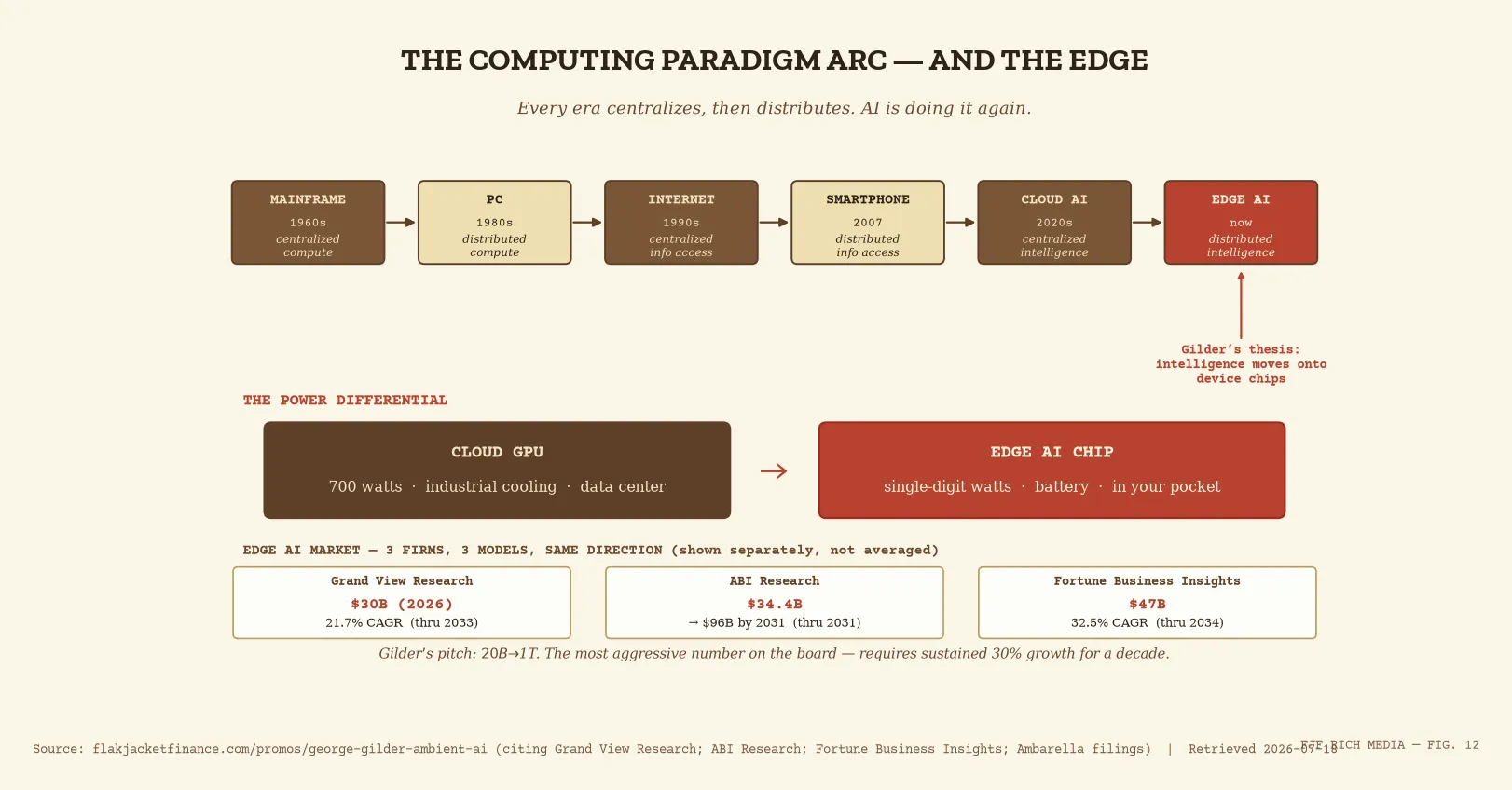
Every computing paradigm follows the same arc. Mainframes centralized processing, then PCs distributed it. The internet centralized information access, and smartphones distributed it again. Cloud AI centralized intelligence in data centers. Edge AI distributes it to devices.
The edge AI market is a number you can look up. Grand View Research pegs it at $30 billion in 2026, growing at 21.7% annually through 2033. Fortune Business Insights has it at $47 billion, growing at 32.5% through 2034. ABI Research tracks $34.4 billion growing to $96 billion by 2031. Three independent firms, three different models, the same direction.
For context: the cloud AI infrastructure market — Nvidia’s home turf — was roughly $150-200 billion in 2025 and growing faster. Edge AI at $30-47 billion is a quarter to a third the size of the cloud market today, but the growth rates imply edge closes a meaningful portion of that gap over the decade. The structural question is whether the value pools at the chip level the way cloud AI value pooled at the GPU level. Different economics, different margins, different concentration.
Gilder frames the opportunity as a $20 billion market growing to $1 trillion. That is the most aggressive number on the board. The most bullish independent research caps out at $446 billion by 2034. Reaching $1 trillion would require sustained 30% annual growth for a decade — the high end of every credible forecast. It is the optimistic tail case, and Gilder is pitching it.
The shift is showing up in real company financials. Ambarella, a pure-play edge AI chipmaker, reported 80% of fiscal 2026 revenue from edge AI applications, up from 70% eighteen months earlier. The revenue migration is happening now.
What Makes Edge AI Different
Running AI in a cloud data center is a brute force problem. You have unlimited power, unlimited cooling, and racks of GPUs. Running AI on a device is a constraint problem. You have a battery, a thermal envelope, and a chip the size of a fingernail.
The chip has to do three things at once: process sensor data, run inference on a local model, and do it all on a few watts of power. A cloud GPU draws 700 watts. An edge AI chip has to draw single digits.
Wall Street spent 2024 and 2025 pricing the 700-watt version of AI. The single-digit version is the one you carry in your pocket. The market has not yet decided what that is worth, which is why Gilder is early to the table — his natural position for four decades.
That constraint is why programmable chips matter. A fixed-function chip does one thing well. A programmable chip can be reconfigured after it is manufactured — updated, patched, repurposed for a new model without respinning the silicon. For defense systems that spend years in development and decades in the field, that flexibility is the whole game. A satellite launched in 2026 needs to run AI models that did not exist when it was designed. Programmable logic makes that possible.
The Technology: eFPGA
The core technology is embedded Field Programmable Gate Array, or eFPGA. Traditional FPGAs are standalone chips — separate silicon you drop onto a circuit board. eFPGA puts the programmable logic inside a custom chip, woven into the architecture of an ASIC or a system-on-chip.
Think of it this way. A traditional FPGA is a separate engine you bolt onto a car. eFPGA is an engine built into the car’s frame, designed as part of the vehicle from the start. Smaller footprint, lower power, tighter integration.
The company behind the pick has a tool called the Australis IP Generator. Customers specify what they need — how much programmable logic, what process node, what power budget — and Australis generates a custom eFPGA core that drops into their chip design. The company licenses this as intellectual property. The customer pays to embed programmable logic inside their own silicon.
For defense applications, the use case is concrete. A radiation-hardened FPGA in a satellite or a missile can be reprogrammed after launch. New algorithms, patched vulnerabilities, updated threat models — all without touching the hardware. The Department of Defense has been funding exactly this capability through its Trusted and Assured Microelectronics program.
The Government Contract
The Pentagon buys qualified suppliers.
The company holds a Category 1A Trusted Supplier designation from the DoD — the highest security classification a chipmaker can carry. That means it is certified to fabricate sensitive circuitry for weapons systems, communications infrastructure, and intelligence platforms. The list of companies with this designation is short.
In December 2025, the DoD awarded the company a contract for Strategic Radiation Hardened FPGAs. The contract ceiling is $88 million. The initial award was $13 million, with Naval Surface Warfare Center Crane as the technical lead. This is a government filing, not a promo claim. You can read the contract number.
The radiation-hardened angle matters because space and defense systems operate in environments where ordinary chips fail. Total ionizing dose, single-event upsets, particle strikes from cosmic rays — a chip in low earth orbit takes punishment a data center GPU never sees. Rad-hard FPGAs are designed to survive it. The company is the prime contractor for the next generation of them.
The Intel Foundry Partnership
The “sub-5nm” claim in the promo is technically accurate and worth understanding. The company joined the Intel Foundry Accelerator program in June 2024, then the Intel Foundry Chiplet Alliance in June 2025. It is the first and only company offering eFPGA Hard IP on Intel 18A — Intel’s most advanced process node.
Intel 18A is a 1.8-nanometer-class process. It uses gate-all-around transistors (RibbonFET) and backside power delivery (PowerVia) — two technologies TSMC has not yet brought to volume production. At the June 2026 VLSI Symposium, Intel announced 18A-P, a performance enhancement delivering 9% higher performance at the same power, entering risk production.
The company announced a mid-six-figure contract for high-density eFPGA on Intel 18A in March 2026. The commercial foundry contract is forecast for Q3 2026. If Intel 18A succeeds commercially against TSMC, being the only eFPGA partner on that node becomes valuable. Intel’s own node history includes difficulties at 10nm and 7nm — a factor Gilder’s thesis accounts for by emphasizing the Pentagon contract revenue as the nearer-term anchor.
The Analyst Consensus
Four Wall Street analysts cover the stock. The consensus is Strong Buy.
Needham initiated coverage in May 2026 with a Buy rating and a $22 price target. Craig-Hallum raised its target from $10 to $27 the same month. Lake Street has a $22 target. Northland Securities is the lone hold, with an $8 target raised from $5.95.
Average price target: $23.67. The stock has been volatile — it traded near $24 in early 2026, pulled back to the $14 range by mid-July alongside a broader semiconductor selloff. The analyst consensus says the fair value is higher than the market price. Whether the market agrees is a separate question.
The Competitive Landscape
The company is not alone in radiation-hardened FPGAs. AMD, through its Xilinx acquisition, makes the Virtex-5QV at 65nm and the Kintex UltraScale XQR at 20nm. NanoXplore builds the NG-ULTRA in Europe at 28nm. BAE Systems partners with Achronix.
The differentiator is process node. The company’s eFPGA on Intel 18A is 1.8nm-class — two generations ahead of AMD’s 20nm rad-tolerant parts. The technology lead is real, and the variable that determines how much it matters is how quickly the commercial Intel 18A contracts convert from pipeline to revenue.
The Thesis in Context
Gilder has been identifying chip-level inflection points for nearly four decades. In 1989, Microcosm argued that the semiconductor would define the technology era. In 2000, Telecosm argued that bandwidth would replace processing power as the defining abundance. In 2018, Life After Google argued that blockchain would decentralize the cloud. In 2025, he argued that government equity stakes in strategic companies would reshape American industry. In 2026, Ambient AI argues that edge computing is the next computing paradigm.
The Ambient AI pitch is the latest expression of the same framework: identify the technology shift, find the small company with the patents and the partnerships at the inflection point, and make the case that the shift is real enough to bet on. The Convergence X campaign runs in parallel under the same Gilder’s Moonshots banner — eight technologies converging at once — and the Golden Hour thesis covers the government equity-stake angle on the same underlying chip supply chain. The rest of the Promo Watch tracks what is live.
Gilder’s track record on technology direction is strong. His track record on stock selection has run the full range — the dotcom era is the instructive example, where the thesis was right and the picks were early enough to look wrong for years before the direction caught up. The Ambient AI thesis has the same character. The edge AI shift is real and measurable. Whether this specific company is the one that captures it is part of what makes the thesis interesting — the technology shift is confirmed by Ambarella’s revenue migration and three independent market research firms, and the question of which company monetizes it first is the one the Pentagon contracts and Intel Foundry partnership are positioned to answer.
What This Comes Down To
The edge AI market is growing, the DoD contracts are real filings, and the Intel Foundry partnership is documented. The analyst consensus says the stock is undervalued. The technology — programmable logic embedded in custom chips on the most advanced process node in American manufacturing — is genuine.
The company is a microcap with quarterly revenue in the single-digit millions and a net loss on the books. The $88 million contract is a ceiling, not a check. The initial $13 million award is what is funded. The remaining $75 million is obligated only if the DoD exercises options over the contract’s lifetime. For dimensionalization: the entire $88 million ceiling equals roughly one day of Lockheed Martin’s revenue. The initial $13 million award is less than two days of Nvidia’s operating income. Defense contracts at this scale do not transform a microcap overnight — they validate the technology and unlock the next, larger contract. The story is the qualification, not the dollar figure.
The commercial Intel 18A contract keeps moving right on the calendar. The competitive landscape includes AMD, a company with roughly 10,000 times the market cap. These are the characteristics of an early-stage defense-tech company positioned at an inflection point — the same profile that describes most of Gilder’s best calls at the stage he identified them.
An operator’s read on this setup: Gilder’s edge-AI shift is real and verifiable — Ambarella’s revenue migration and three independent market research firms confirm the direction. The specific company is a bet that the first eFPGA partner on Intel 18A translates a process-node lead into commercial revenue before a competitor with 10,000 times the resources decides to enter the same lane. Defense-tech microcaps that survive long enough to convert their first major prime contract into follow-on awards are the ones that compound. The ones that do not survive are the ones where the commercial contract keeps moving right until the cash runs out. Gilder’s track record on the directional thesis is strong. His track record on which company monetizes the thesis first is the variable. He was right about bandwidth. Half the companies he picked in Telecosm were not the ones that captured it.
Gilder’s argument is that the technology matters more than the balance sheet at this stage, that being the first eFPGA partner on Intel 18A is a structural advantage worth paying attention to now, and that the edge AI market is large enough that even a niche player with the right contracts can compound for years.
The idea is worth sitting with.