This Takeover Targets review examines Dylan Jovine’s high-end product in his Behind the Markets lineup. The flagship Behind the Markets service runs $49/year; Takeover Targets starts at $1,497 — a 30x price jump that begs the question of what you get for the difference.
The short version: merger arbitrage picks with a claimed 97.5% success rate on 36 closed trades since 2020, only one loser in that stretch, and an average gain of 24% per deal. Those numbers need context before they mean anything. For readers comparing Jovine’s services, the Behind the Markets Review: Dylan Jovine’s Service covers the $49 flagship, the Biotech Insider Review: Dylan Jovine’s $2,997 Picks covers the biotech-focused premium tier, and the Breakthrough Wealth Review: Jovine’s $1,997 Service covers the micro-cap moonshot product.
What Takeover Targets Is
Takeover Targets is a weekly stock recommendation service that identifies companies Jovine believes will be acquired. The strategy is merger arbitrage mixed with pre-takeover speculation. Subscribers get one stock pick per week plus trade alerts when deal announcements hit.
The service has existed since roughly 2020. Jovine reports a 97.5% success rate over the first two years with a pick “every 17 days.” More recent marketing says 36 trades since January 2020 with only one losing position.
The underlying thesis is straightforward. Small biotech and technology companies trade at a discount to what a larger strategic buyer would pay. When a big pharma company needs pipeline assets or a tech giant needs capability, they buy the cheaper company rather than build it from scratch. Jovine tries to get in before the deal is announced.
The Track Record
The numbers Jovine cites are specific and worth examining.
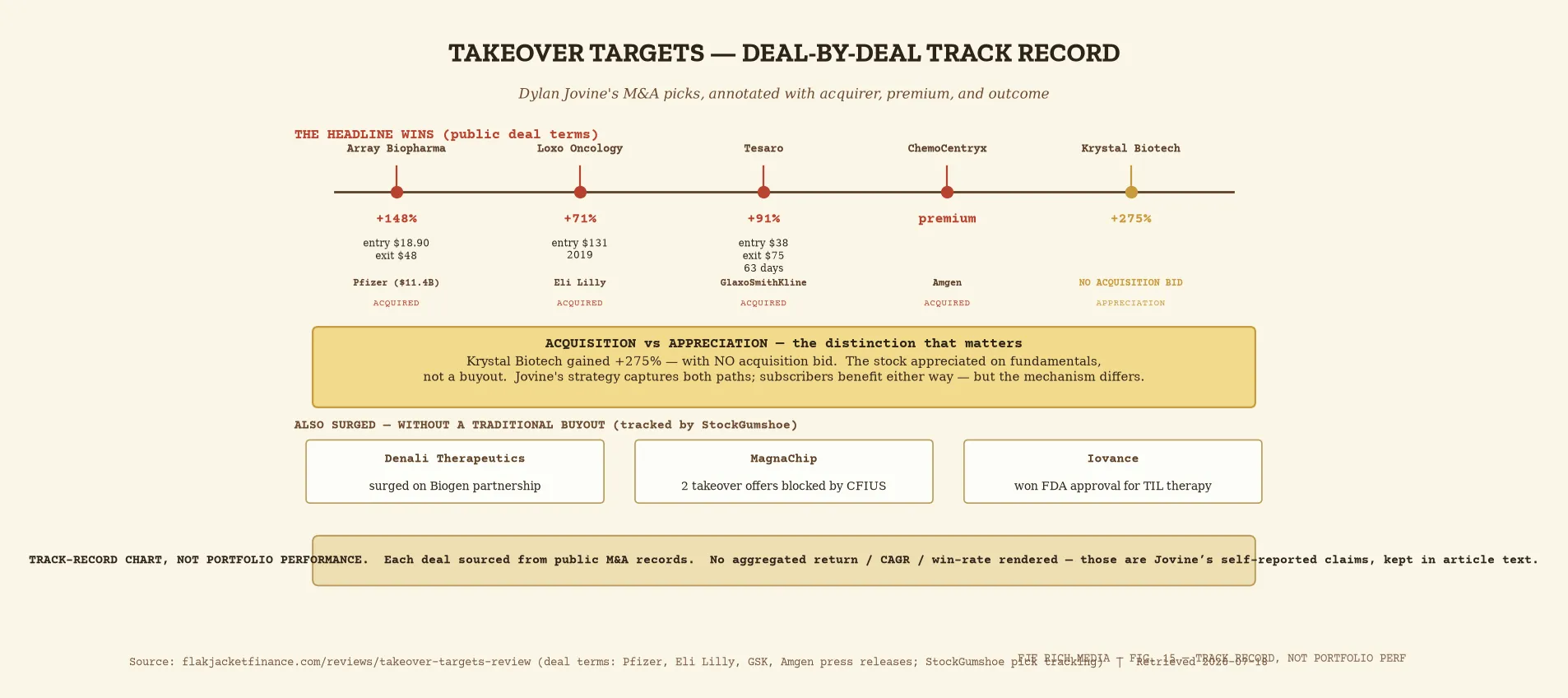
According to Jovine’s published track record, Array Biopharma was recommended at $18.90 before Pfizer acquired it at $48/share for $11.4 billion — a +148% gain. Loxo Oncology was recommended at $131 in January 2019 before Eli Lilly acquired it later that year — +71%. Tesaro was recommended at $38 in October 2018, and GlaxoSmithKline acquired it 63 days later at $75 — +91%. Past performance does not guarantee future results.
Those three are the headline wins — real acquisitions with public deal terms, and anybody who bought those stocks at those prices and held through the acquisition did make that money.
ChemoCentryx and Krystal Biotech are also cited as wins. ChemoCentryx was acquired by Amgen at a significant premium. According to Jovine’s track record, Krystal Biotech gained +275% from his recommendation point, though the thesis on that one was a takeover that did not actually happen — the stock appreciated on fundamentals, not an acquisition bid.
The 36-trade track record since 2020 with only one loser reflects Jovine’s internal performance tracking. The picks themselves are observable in the market. Several documented picks — Denali Therapeutics, MagnaChip Semiconductor, Iovance Biotherapeutics — followed different paths to the same outcome. Denali surged on a partnership announcement with Biogen. MagnaChip received two takeover offers from Chinese firms that were blocked by CFIUS. Iovance won FDA approval for its TIL therapy. None of those three closed a traditional acquisition, and each produced meaningful price movement from the recommendation point.
This is the distinction between acquisition and appreciation. A 71% gain on Loxo Oncology was a genuine acquisition. A stock that rises on partnership news, regulatory approval, or fundamental business momentum also benefits subscribers — the position works, just through a different mechanism than a buyout. Jovine’s strategy captures both paths because the underlying thesis is mispricing: the market undervalues the likelihood that something transformative happens to these companies. Past performance does not guarantee future results.
The Pricing
Takeover Targets has three tiers:
The annual plan is $1,497 for 12 months. The two-year plan is $3,997. The VIP Unlimited plan runs $4,997 and lasts as long as the service publishes.
All tiers include weekly research reports, monthly portfolio updates, real-time trade alerts, and access to a members-only portal. Each comes with bonus reports — the “Number 1 Biotech Takeover Target for the Month,” a strategy video on merger arbitrage, and a sector-specific report.
Every plan has a 30-day money-back guarantee.
What You Get
The weekly pick cadence is the core product. Each issue walks through the target company, the acquirer thesis, the estimated timeline, and the expected return. Subscribers also get special situation briefings when takeover rumors surface or deal terms change.
The model portfolio shows all open and closed positions with entry prices and outcomes. This is the same transparent approach Jovine uses across his product line, applied here to a higher-risk product.
According to the service’s marketing, Takeover Targets targets annualized returns of 10-20% from the merger arbitrage component, with larger gains from pre-takeover speculation positions. The arbitrage trades — buying stocks after a deal is announced, betting on completion — are lower risk but lower return. The pre-announcement picks are the high-upside bets.
How the Strategy Works in Practice
Takeover Targets is a single-strategy service focused on a specific niche — companies positioned for acquisition or transformative events. The opportunity set tracks the broader M&A cycle. When interest rates are low and capital is abundant, the deal flow is heavier. When conditions tighten, the timeline between recommendation and catalyst stretches out, and the positions require more patience.
The service also requires attention. Takeover trades are time-sensitive — a deal announcement can move a stock 30% in a day, and a deal that falls apart can reverse that just as quickly. The merger arbitrage component, buying after a deal is announced, provides a more structured risk-return profile. The pre-announcement picks carry more upside and more variability. The 30-day refund window lets subscribers experience the weekly research flow and the trade alert cadence before committing to the full year.
The Comparison
Behind the Markets, Jovine’s flagship service, costs $49/year and publishes one pick per month. According to Behind the Markets, the track record there is 72.9% winners on 70 closed trades with a 39.96% CAGR from 2018 to 2025. Past performance does not guarantee future results.
Takeover Targets costs 30 times more and publishes four picks per month. The track record claims are stronger — 97.5% winners — but on a smaller sample and a shorter timeframe.
The price difference reflects the audience. Behind the Markets is a value product for long-term mid-cap investors. Takeover Targets is a premium product for speculators who want frequent merger arbitrage ideas.
Where Takeover Targets Fits
Takeover Targets is a service built for a specific approach to the market. The strategy combines merger arbitrage with pre-takeover speculation, and the track record — 97.5% winners on 36 closed trades — reflects a methodology that identifies companies the market is underpricing for transformative events. The weekly research flow, real-time trade alerts, and model portfolio give subscribers the structure to follow Jovine’s process in real time.
The pricing reflects the specialization. At $1,497 per year, Takeover Targets sits well above the $49 flagship service. The difference is the pick cadence — four picks per month instead of one — and the focus on a strategy that requires active monitoring and specialized research. The 30-day refund gives a full month of live picks and trade alerts to evaluate the research quality.
The 36-trade track record since 2020 is real in the sense that those trades happened and the outcomes are documented. Whether the next 36 follow the same pattern depends on the M&A cycle and Jovine’s ability to identify targets before the market reprices them. His methodology has produced results across biotech, semiconductors, and pharma — three sectors where strategic acquisitions are a structural feature, not a seasonal event.
Where This Fits
Right for active speculators who want frequent merger-arbitrage ideas and can monitor time-sensitive trades during market hours — the weekly cadence and the trade-alert structure serve a hands-on operator, not a set-and-forget portfolio; wrong for passive investors, income seekers, or anyone who wants broad market exposure — the $1,497 price and the single-strategy focus put this in a specific niche that does not double as a core holding. Our default: this is the right product for a reader who already runs a brokerage account actively and wants a specialized M&A sleeve sized as casino-bucket money; a reader who wants Jovine’s methodology at a lower commitment and cadence is better served starting at the $49 Behind the Markets flagship and evaluating the upgrade from inside the research flow. The 30-day refund window is the structural feature that lets a subscriber run a full month of live picks before the commitment locks in.
Flack Jacket Finance covers investment newsletters as an independent third party. We do not reveal paid picks, we do not trash the gurus we cover, and we do not sell the promos we review.