Jim Rickards isn’t the only one warning about AI debt.
Michael Burry — the neurologist-turned-hedge-fund-manager from The Big Short, the guy who saw the 2008 housing collapse before anyone else — has been sounding the alarm too.
He’s not selling a presentation or running a campaign — he’s posting on X. And what he’s found should concern anyone paying attention to where AI money is coming from.
Here’s what Burry said, what it means, and why it independently validates the thesis Rickards has been making for months.
What Burry Actually Said
In February 2026, Burry shared the Citrini Research report titled “The 2028 Global Intelligence Crisis” on X. His caption, verbatim: “And you think I’m bearish.” One line, no elaboration, no thread — that’s vintage Burry — cryptic and clipped.
The Report That Broke the Market
The Citrini report, published February 2026 on Substack, is a thought exercise written as a macro memo from June 2028. It imagines a world where AI agents have replaced white-collar workers at scale, creating what the authors call an “Intelligence Displacement Spiral.”
The core argument: For the first time in modern economic history, the most productive asset in the economy — intelligence — is producing fewer jobs, not more. The premium on human intelligence is unwinding. And the financial system, built over decades on the assumption that human minds are scarce, has no framework for that.
The report was explicit that it was a scenario, not a prediction — it said so upfront. The market didn’t care.
The day the report went viral, the Dow Jones Industrial Average fell 800-plus points. IBM dropped 13% — its worst single day since 2000 — while DoorDash fell roughly 7%, Visa lost 4.5%, and Mastercard slid 6.3%. Software firms like Datadog, CrowdStrike, and Zscaler each fell more than 9%.
Total views on the report: approximately 4.5 million. Discussion on X: roughly 16 million views.
A single Substack article triggered a broad tech sell-off worth hundreds of billions. That’s a market that knows something is off but can’t name it.
The Fugazi Pipeline
A few months later, Burry went further.
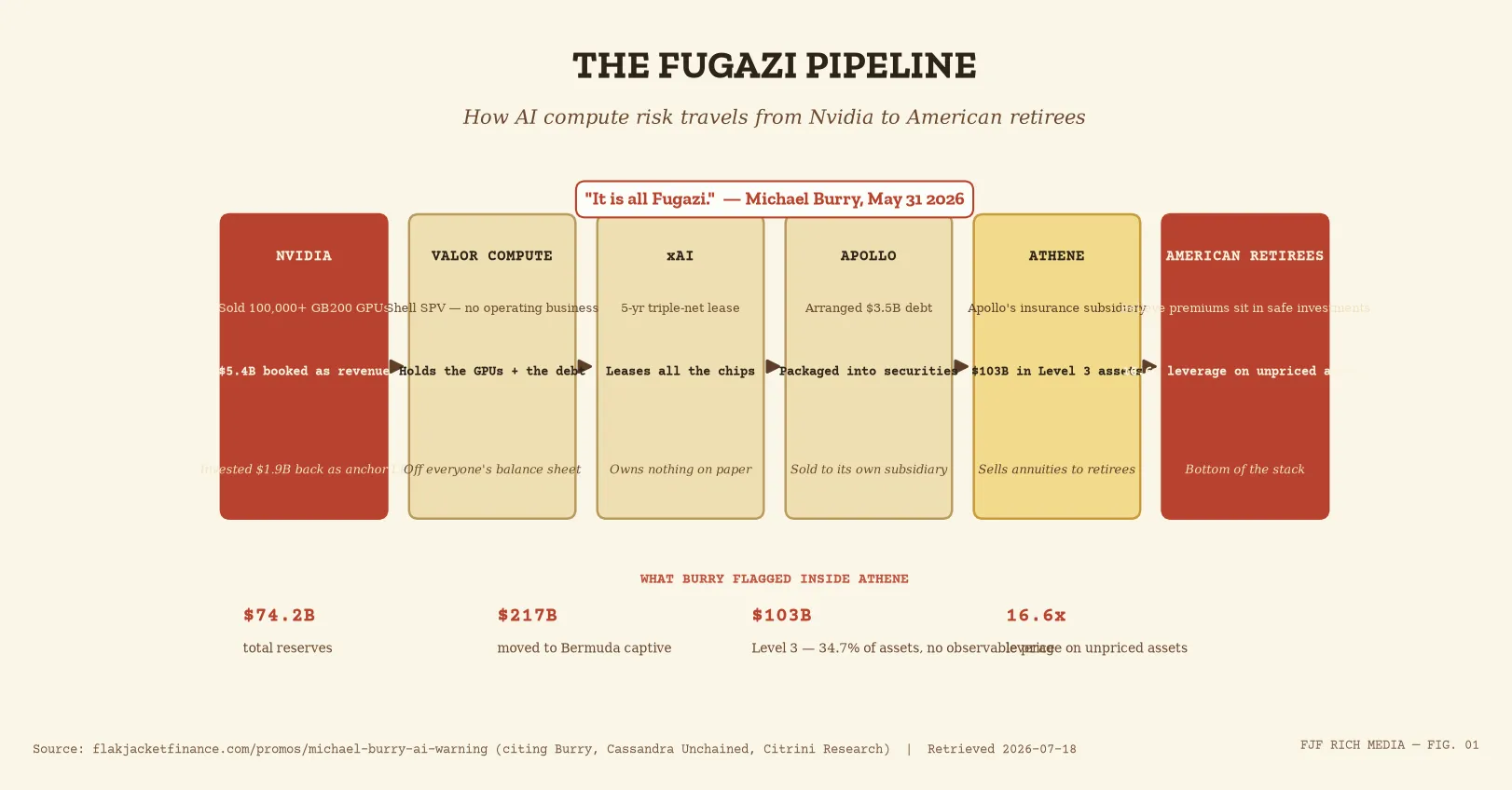
On May 31, 2026, he published a detailed diagram on his Cassandra Unchained Substack titled “The Retiree/Apollo/Nvidia/Bermuda/AMAPS/xAI Pipeline.” His verdict on the whole structure: “It is all Fugazi.”
Fugazi is Italian slang for “fake.” The structure, he argues, is engineered to make risk disappear from balance sheets — and land on people who don’t know it’s there.
Here’s how it works:
Nvidia sold 100,000-plus GB200 GPUs to Valor Compute Infrastructure, a shell special purpose vehicle with no operating business, for $5.4 billion. Nvidia booked the full amount as completed revenue while also investing $1.9 billion of its own money back into Valor as an anchor limited partner.
xAI — Elon Musk’s AI company — leases all those chips through a five-year triple-net lease. xAI owns nothing on paper. The GPUs, and the debt used to buy them, appear on nobody’s balance sheet except a shell company.
Apollo Global Management arranged $3.5 billion in debt for the deal, packaged it into securities, and sold those securities to Athene — Apollo’s own insurance subsidiary. Athene sells fixed and indexed annuities to American retirees, and the pipeline mapped end to end shows Nvidia recording revenue while Apollo collects fees across every layer. xAI gets $5.4 billion in compute off balance sheet. And American retirees, who believe their annuity premiums sit in safe, stable investments, sit at the bottom of a 16x-leveraged structure holding $103 billion in assets with no observable market price.
Burry flagged four numbers inside Athene:
- $74.2 billion in total reserves
- $217 billion in assets moved to a Bermuda captive insurer outside US regulatory oversight
- $103 billion — 34.7% of all assets — classified as Level 3 (no observable market price)
- 16.6x leverage on those unpriced assets
That’s retiree money funding AI compute through an offshore shell, packaged by the same firm that owns the insurance company, carrying risk nobody can price.
Where Burry and Rickards Converge
Jim Rickards has been warning that AI companies are using Enron-style off-balance-sheet structures to hide debt. He points to $200 billion in AI debt raised in 2025 — a number our fact-check confirmed is real and probably bigger.
Burry found the exact mechanism — he traced the pipeline from GPU sale to retiree balance sheet, showed the leverage, and named the shell companies.
They arrive at the same conclusion through different doors — Rickards focuses on the debt structures while Burry focuses on labor displacement, but both agree the financial architecture underpinning AI is fragile, with opaque debt and returns the market has not yet validated. Burry has noted that 38% of current high-yield bond issuance is linked to AI compared to 40-50% for tech-media-telecom in 2000, and 87% of venture capital today goes to AI versus below 40% in 1999.
The Honest Take
When the guy who called the 2008 housing crash and the former CIA advisor are both pointing at the same structural risk, it is worth paying attention. They are not both right about timing — nobody is, and Burry was early on housing too, starting his short in 2005. But they are both pointing at real structural risk, and the Citrini report and the Fugazi pipeline are evidence, not predictions. What matters is that two independent analysts tracing the same fault line through different terrain have arrived at the same warning.
This is an independent analysis piece. We do not sell, endorse, or speculate on any investment product. We report what the gurus are saying and what the data shows.