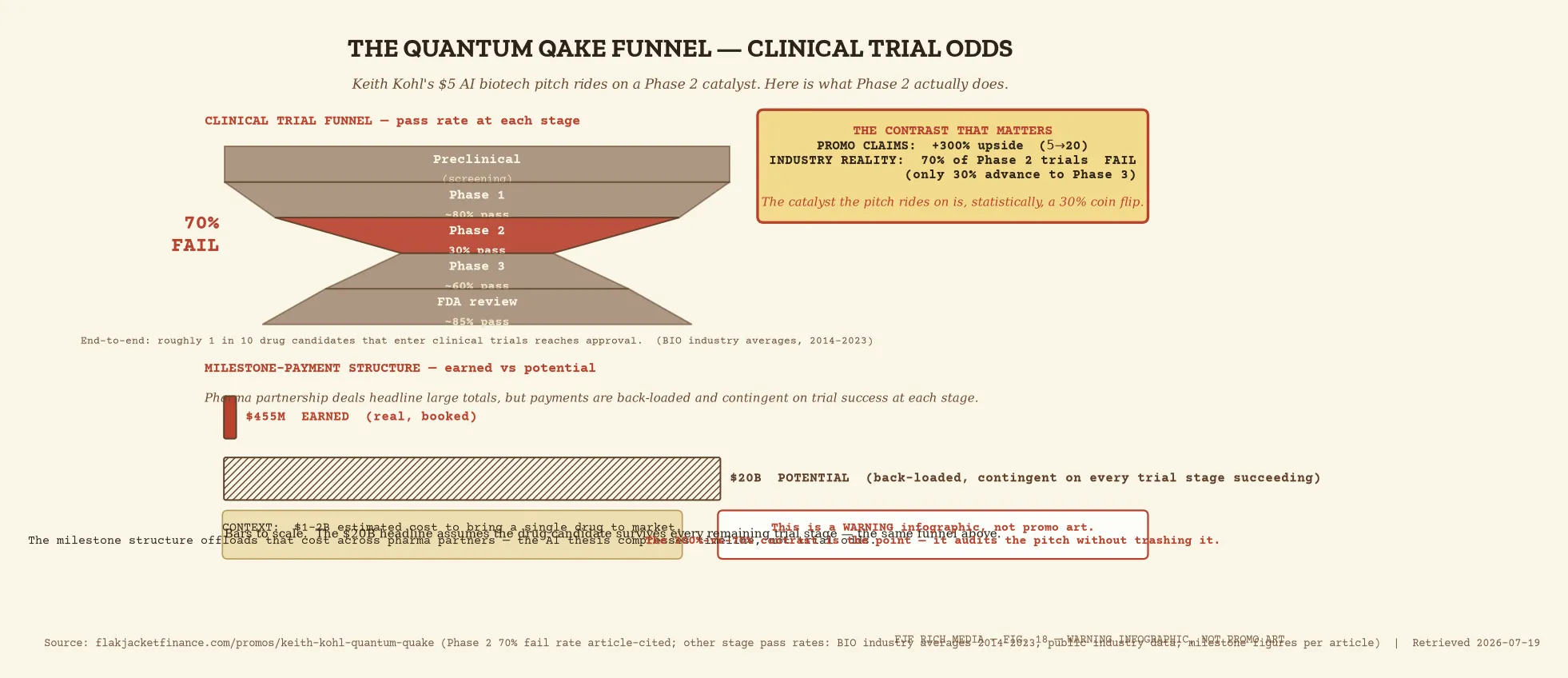
Keith Kohl calls it a “Quantum Quake” — the moment AI drug discovery stops being a science experiment and starts producing cures fast enough to shift the economics of traditional pharmaceutical research. The pitch, from Angel Publishing’s Topline Trader, arrived in inboxes in mid-July 2026, and it pairs a biotech catalyst trade with the AI drug-discovery thesis as its framing.
What the Quantum Quake Campaign Is
The promo is titled “Bioengineering: Cashing in on AI Drug Development Before It’s Too Late.” It pitches a single “$5 AI biotech stock” that uses artificial intelligence to identify drug compounds faster and cheaper than the traditional pharmaceutical pipeline. The core thesis: this company has built an AI platform that maps biological data at industrial scale, partners with major pharmaceutical companies, and stands to earn milestone payments as its drug candidates move through clinical trials. Kohl frames it as the convergence of AI and biotech with a Phase 2 clinical trial catalyst that he says could trigger a 300% gain.
Stock Gumshoe published a de-tease on July 13, 2026. This is an email-driven pitch from a biotech-focused publisher with a niche audience, distinct from the TV-ad campaigns that drive wider circulation.
Who Is Keith Kohl
Keith Kohl is an editor and investment director at Angel Publishing, a Baltimore-based financial publisher running several energy and technology newsletters. He has been covering energy and technology markets for nearly two decades and writes for an audience of over 300,000 readers through the Energy and Capital e-letter.
His main product is Topline Trader, a biotech catalyst trading service priced at $799 per year with a 90-day refund window. The service focuses on the FDA calendar — drug trial readouts, approval decisions, and the clinical trial catalysts that move biotech stocks. Prior Topline Trader pitches have covered quantum computing and sustainable aviation fuel. Angel Publishing is a smaller, US-domestic publisher, not part of the Agora or MarketWise networks, and this is an email-driven pitch with a niche audience of readers specifically searching for it.
The Claims, Quoted and Dated
The promo copy, as documented by Stock Gumshoe on July 13, 2026, makes these claims:
“World Stunned as ‘AI Doctor’ Produces Cures at Light Speed” — AI drug discovery positioned as a paradigm shift.
“Bill Gates, BlackRock, and Citigroup Are ALL Loading up on This Tiny $5 AI Biotech Stock” — The pitch says major institutional investors have taken positions. Institutional holdings are filed quarterly with the SEC, so this is verifiable.
“partnership deals with giants like Bayer, Roche, Bristol-Myers Squibb, and Merck” — The pitch says the teased company has earned $455 million in milestone payments with the potential to receive another $20 billion more. Pharmaceutical partnership deals are public — they appear in press releases and SEC filings.
“a move that could easily send its shares to $20 or more, handing investors a quick 300% gain” — A move from $5 to $20 is a 300% gain. The “quick” framing points to the catalyst-driven timeline biotech stocks can move on — biotech catalyst trades can move fast on trial readouts, and they can move the other direction just as fast.
The AI Drug Discovery Thesis in Plain English
Traditional drug discovery is slow and expensive. A pharmaceutical company spends years screening compounds, running preclinical tests, and pushing candidates through three phases of clinical trials before the FDA weighs in. The cost of bringing a single drug to market is estimated at $1-2 billion, and most candidates fail.
AI drug discovery companies argue they can compress that timeline. An AI platform trained on massive biological datasets can predict which compounds are likely to work against specific targets — faster and at a fraction of the cost. The pitch claims the teased company can identify drug compounds “10x faster at 80% lower cost.”
That thesis is real, and it is an established one. NVIDIA put $50 million into one AI biotech company in 2023, and Jensen Huang has publicly called generative AI “a revolutionary tool to discover new medicines.” The connection to NVIDIA ties the AI biotech theme to the broader AI infrastructure buildout that every publisher on the radar is pitching right now — the same buildout the public sector is funding through the Genesis Mission’s AI drug-discovery challenges, which we mapped in the government AI stocks guide. The teased company’s partnerships with Bayer, Roche, Bristol-Myers Squibb, and Merck suggest that major pharmaceutical companies are willing to pay for access to the platform. The path from those partnerships to approved drugs and sustained earnings runs on the clinical-trial timeline, which is measured in years — a different timeline than the catalyst the pitch builds its 300% frame around.
What You’d Actually Be Buying
Topline Trader costs $799 per year. The refund window is 90 days — longer than most publishers offer, which is worth noting because biotech catalyst trades are inherently binary. A drug trial either succeeds or fails, and the stock moves accordingly. A 90-day window gives you a real chance to evaluate the service through at least one catalyst cycle.
The product is a biotech catalyst trading service. You are buying access to Kohl’s FDA calendar analysis, his drug trial assessments, and his specific trade recommendations timed to clinical trial readouts. This is a high-risk, high-reward category. Biotech stocks can double on a positive trial result and lose half their value on a negative one. This is casino-bucket money — a small percentage of your portfolio that you can afford to lose completely — not nest-egg money.
What the Thesis Depends On
Valuation at the $5 level. A $5 stock is not necessarily cheap. Biotech companies with clinical-stage pipelines often trade below $5 because they are burning cash, have no approved drugs, and their entire valuation rests on the drug candidate surviving clinical trials. The price tells you what the market thinks today; it says nothing about what the company is worth.
The Phase 2 trial outcome. The pitch says a Phase 2 trial catalyst is “just around the corner” and frames it as a 300% upside opportunity. Phase 2 trials fail roughly 70% of the time across the biotech industry. A biotech catalyst trade is, by its nature, a bet on a binary trial readout — the 70% figure is the industry baseline the trade runs against.
The milestone-payment structure. Pharmaceutical partnership deals typically include large headline numbers for total potential milestone payments, but those payments are back-loaded and contingent on clinical success at each stage. A $20 billion headline might mean $50 million upfront and the rest spread across a decade of trial outcomes that may never arrive. The headline figure and the cash-flow figure run on different timelines.
The competitive landscape. The pitch positions the teased company as the leader in AI drug discovery, but the field is crowded. Multiple companies are building AI platforms for drug discovery, and the competitive landscape shifts quickly. The thesis depends on the teased company maintaining a platform advantage against larger, better-resourced entrants.
What a Careful Reader Does Next
The Quantum Quake is a biotech catalyst pitch wrapped in an AI thesis, and both the biotech angle and the AI angle are real stories. The specific stock Kohl is teasing is one way to play either one, and the catalyst-trade structure is what ties the two together — the AI thesis provides the framing, and the clinical-trial calendar provides the timing.
If the AI drug discovery thesis is the part that interests you, the starting point is the public record. Companies that have received NVIDIA investment or partnership are publicly disclosed in press releases and SEC filings. Pharmaceutical partnership deals are announced publicly. Clinical trial results are published on ClinicalTrials.gov. The claims in this pitch — the partnerships, the milestone payments, the institutional holdings — are all verifiable without buying the product.
If biotech catalyst trading is the strategy that interests you, the risk profile comes with the category. This is a product where one trial result can move a stock 50% in either direction in a single day. The 90-day refund window is a reasonable window to evaluate whether Kohl’s methodology and trade timing fit a reader’s risk tolerance, and the terms on the order page are the ones that govern that window.
The “Quantum Quake” framing is a good headline. The underlying thesis — that AI is changing how drugs are discovered — is a real story that will play out over the next decade. The single $5 stock is one entry point into that story, and the catalyst-trade structure is what gives the pitch its near-term timing frame.
For more campaign explainers, see the Promo Watch board.