Jeff Brown has a number that stops you cold.
Eight thousand percent. That is the revenue growth rate he attributes to Anthropic, the AI company behind Claude, in his “Anthropic Master Plan” presentation from May 2026. The claim comes from the CEO’s own projections. Revenue jumped from roughly $2 billion to a level that would put it among the fastest-growing enterprise software companies in history. The Anthropic growth rate thesis is built on that number and what it means for the infrastructure companies feeding the buildout.
Eight thousand percent in one year is a category of its own.
Brown is the one presenting this number, and his background shapes how he sees it. He spent 25 years as a technology executive — not a financial analyst. He ran divisions at Qualcomm, NXP Semiconductors, and Juniper Networks, the companies that built the wireless and networking infrastructure underneath the last two technology cycles. He was President and Representative Director of Juniper Networks Japan. He ran NXP’s Japan operations. He lived in Tokyo for nearly two decades, building organizations that generated hundreds of millions in revenue. His degree is in aeronautical and astronautical engineering from Purdue. He also earned a management degree from London Business School and attended Yale’s School of Management.
That matters here. A former financial analyst looks at 8,000% and sees a number. A former semiconductor and networking executive looks at 8,000% and sees a demand curve he has watched before — the shape of a buildout where the infrastructure layer is scrambling to keep up with the application layer — see how to invest in Anthropic for the Reg CF / Reg A+ mechanism. Brown was inside Qualcomm when mobile data demand went vertical. He was inside Juniper when internet traffic doubled and doubled again. He has seen the pattern where the company closest to the constraint grows faster than the companies using the constraint. Anthropic is using the constraint. The companies Brown is pointing at are building it.
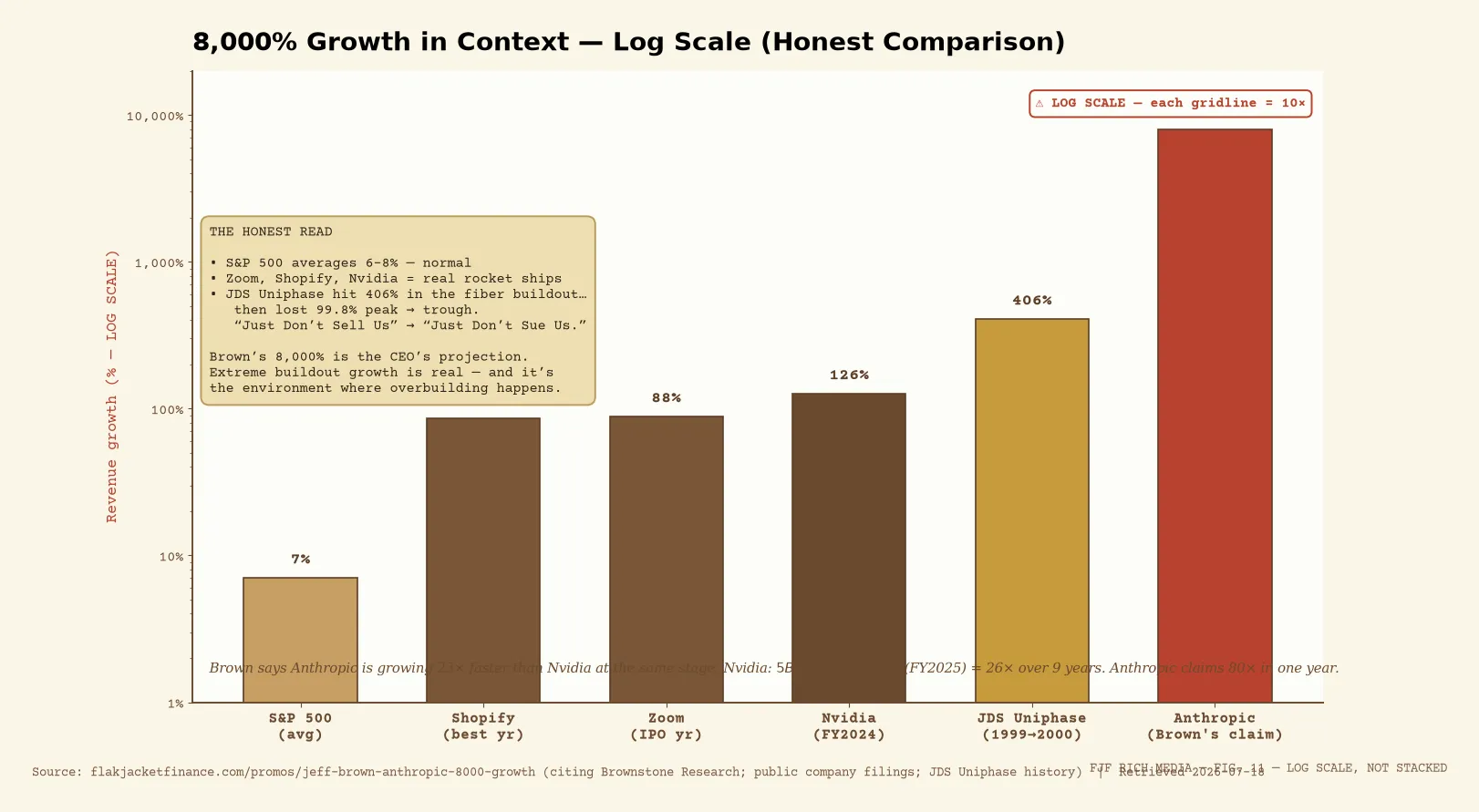
Most people have never seen a company grow at that speed because public companies do not. The S&P 500 average revenue growth rate hovers around 6-8% annually. A company growing at 100% per year is considered a rocket ship. Zoom did 88% revenue growth in its IPO year. Shopify did 86% in its best year. Nvidia, in the middle of the AI boom, grew 126% in fiscal 2024.
Eight thousand percent means something different. It means the company is in a phase where the revenue base is small enough that each new contract is multiple multiples of the prior quarter’s total. It is the shape of a company that has crossed a product-market fit chasm and is now scaling into an addressable market that is itself expanding.
What 8,000% growth means in numbers
Anthropic started 2024 with roughly $2 billion in revenue. If the 8,000% figure holds, it would be among the largest enterprise software companies on earth despite being a fraction of their age.
A company growing at 8,000% in a single year is not going to sustain that rate. The base effect alone makes it impossible. When a $2 billion company grows 8,000%, the new revenue base is enormous. The next year, growing at even 100% off that new base would be more revenue than most Fortune 500 companies add in a decade.
The rate will not hold at that level. The trajectory is what matters.
The historical comparison that matters
Brown’s materials compare Anthropic’s growth to Nvidia at a comparable stage. He says Anthropic is growing 23 times faster than Nvidia was at the same point in its lifecycle. That is a specific comparison, and it is worth sitting with.
Nvidia’s hockey stick started in 2016 when the company recognized its GPUs were the only hardware that could train deep learning models. Revenue grew from $5 billion in fiscal 2016 to $130 billion in fiscal 2025. That is a 26x increase over nine years. Anthropic is claiming an 80x increase in a single year.
The difference is market structure: Nvidia sold hardware that every AI company needed, while Anthropic sells a model that competes with OpenAI, Google’s Gemini, and Meta’s Llama. The competitive dynamics are different. Nvidia’s moat was the CUDA ecosystem and a distribution network that took years to replicate. Anthropic’s moat is safety research and enterprise trust — a moat that requires continuous proof, unlike installed base lock-in.
The framing matters because it tells you how Brown thinks about the scale of the opportunity, regardless of whether either comparison validates the other. He is positioning Anthropic as the fastest-growing business in the history of capitalism.
There is a historical parallel worth knowing, because infrastructure companies growing at extreme rates during a buildout have a specific pattern. JDS Uniphase was the picks-and-shovels play of the fiber optic buildout — the company that made the optical components everyone needed to build the internet’s backbone. In fiscal 1999, JDS Uniphase had $282.8 million in revenue. In fiscal 2000, it reported $1.43 billion — a 406% increase in a single year. The stock peaked at $1,227 per share. At its high, JDS Uniphase had a market capitalization larger than Cisco and Intel combined. It was the hottest infrastructure stock in the hottest buildout of the era.
Then the buildout oversupplied as carrier spending paused and inventory piled up. JDS Uniphase lost 99.8% of its value from peak to trough. The acronym on Wall Street changed from “Just Don’t Sell Us” to “Just Don’t Sue Us.” The company survived — it still exists — but the shareholders who bought at the top did not recover in their lifetimes.
The point carries past the headline. Extreme growth rates during a buildout are real, and they are also the environment where overbuilding happens. The infrastructure thesis and the overbuild thesis are the same thesis viewed from different points in the cycle. Brown is early in the cycle. The historical pattern says the cycle has a back half.
The citations
The presentation draws on real sources. Bloomberg confirmed Anthropic is moving toward a “blockbuster IPO” with initial SEC paperwork filed (May 2026). The Wall Street Journal, citing The Atlantic, called it “the fastest-growing business in the history of capitalism.” CNBC called it “the #1 tech disruptor in the world.” Time magazine wrote that it “holds the keys to perhaps the most powerful technology of all time.”
Those sources confirm that the market is watching Anthropic as a major event, though none confirm the 8,000% growth number directly.
The IPO timing question
Brown’s presentation suggests a public debut could arrive by the end of the month. That is a tight timeline. The reality is that SEC paperwork can take months or longer to clear, especially for a company of Anthropic’s complexity. The SpaceX connection — Elon Musk’s Colossus supercomputer in South Memphis powers Anthropic’s compute, as disclosed in the SpaceX S-1 filing — is a real infrastructure link, but it does not control the IPO calendar.
The IPO could happen in weeks or in 2027, and the timing is less important than the direction. The SEC filing is a signal that the company has started the process, and that process has a defined end state.
The Day-One Retirement Plan
Brown’s “Day-One Retirement Plan” concept is built on a specific idea: the moment a technology company goes public is the single most wealth-creating event in its lifecycle. The examples are real.
Facebook opened at $38 in 2012, where a $1,000 investment at IPO would be worth over $1 million today. Uber opened at $42 in 2019, with a $1,000 investment worth over $1.6 million. Google opened at $100 in 2004, and a $1,000 investment would be worth over $2.3 million.
The full picture includes companies that never hit those returns. Snap opened at $17 in 2017 and has never traded above $60. Peloton opened at $29 in 2019 and trades below $10. The Day-One return sits at the upper bound of a distribution that includes losses — which is exactly the problem Brown’s pre-IPO thesis is designed to avoid.
Wall Street has a phrase for this distribution. They call it “the IPO lottery.” The examples Brown cites are the winners. Getting in at the IPO price means accepting the lottery, while getting in before the IPO is how you step outside it.
The pre-IPO window is where the asymmetric opportunity lives. Brown’s thesis is that getting in before the IPO is the only way to capture the full valuation step-up. The mechanism he identifies is Regulation Crowdfunding and Regulation A+ — SEC rules that allow non-accredited investors to participate in private company offerings with starting investments under $50. These rules exist to let everyday investors into deals that were historically reserved for venture capital firms.
The bonus reports
The presentation includes bonus reports that expand the thesis. “The Elon Musk Moonshot” covers a robotics play with a 7 million percent growth claim — a number that makes 8,000% look modest. “How to Profit from Elon Musk’s New Terafab Project” covers a $55 billion infrastructure build. They are supporting pillars for the same thesis: the companies building the physical infrastructure for AI are the ones that will compound through the cycle.
The 8,000% number in context
Eight thousand percent is a specific number — the CEO’s own projection, supported by the visible growth in Anthropic’s enterprise client base. The company has roughly 1,000 enterprise clients using Claude for legal contract analysis, clinical report generation, and software coding. Each of those clients is a multi-year contract. Each contract is larger than the last.
The 8,000% number is probably not sustainable, and it does not need to be. Whether Anthropic grows 8,000% every year or 100% off a much larger base, the Day-One IPO valuation will be a significant number.
The thesis is about the trajectory, not the headline growth rate, and the idea is worth sitting with.
What Is the Anthropic Growth Rate Claim?
The Anthropic growth rate claim is that Anthropic is growing 8,000 percent in a single year, 23 times faster than Nvidia at the same stage. Brown’s argument is that the companies building the infrastructure layer for AI are growing faster than the AI companies themselves, and his pitch identifies the picks positioned at that constraint. The 8,000 percent number comes from Brown’s May 2026 Anthropic Master Plan presentation. For the physical-buildout side of the same thesis, see Anthropic Stock: The Terafab $55B Chip Bottleneck. For the publisher-level track record on Brown’s picks, see Brownstone Research: Jeff Brown’s Track Record. For the full index, see Promo Watch.