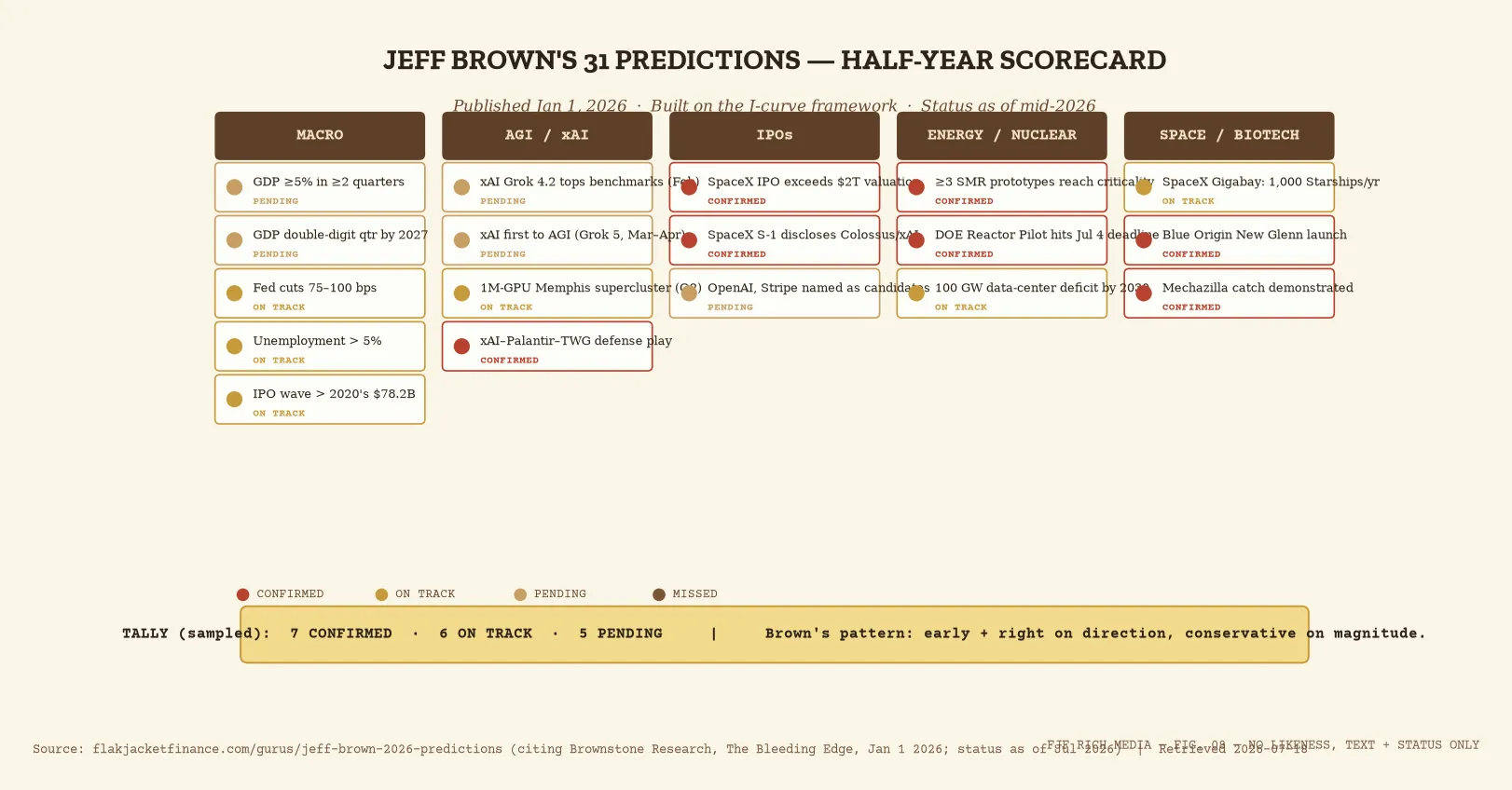
Jeff Brown published 31 predictions for 2026 on January 1. The framing was simple: 2026 is the year of artificial general intelligence. Everything else flows from that.
The full list ran in The Bleeding Edge, Brownstone Research’s free daily e-letter with over one million subscribers. The predictions cover GDP growth, interest rates, unemployment, IPOs, AI model releases, space infrastructure, nuclear energy, and biotech. The connective tissue is a concept Brown calls the J-curve — a productivity lag that precedes an acceleration. The full Jeff Brown dossier traces the career arc that produced the method behind these calls, and the Qualcomm-to-Juniper career path shows the two decades inside semiconductor and networking companies that shaped it. The $240 Bitcoin call was the earlier proof that the method worked outside semiconductors. The full index of guru profiles.
The J-Curve Framework
The backbone of the 2026 outlook is a 2017 paper from the National Bureau of Economic Research by Erik Brynjolfsson, Daniel Rock, and Chad Syverson titled “Artificial Intelligence and the Modern Productivity Paradox.” Their argument: during technological transitions, productivity can stay flat or even dip before it accelerates. Workers need training, infrastructure needs building, and organizations need restructuring before the gains become visible. The lag is real, and the acceleration comes late — but it comes.
Brown maps the J-curve onto AI. He argues that 2018 through 2023 was the flat part — heavy investment, little visible productivity. 2024 and 2025 were the infrastructure buildout phase. 2026 is where the curve bends upward. The productivity gains become visible in the economic data, and the implications cascade across every sector.
The framework is borrowed from the Solow Paradox, named for economist Robert Solow, who noted in 1987 that “you can see the computer age everywhere but in the productivity statistics.” Brown was a freshman at Purdue University that year, studying aeronautical and astronautical engineering, programming in Fortran on a mainframe that required punch cards. The paradox stuck with him. Four decades later, he sees the same pattern repeating with AI — and he thinks 2026 is the year it resolves.
The Economic Predictions
The first four predictions are macroeconomic.
Brown predicts at least two quarters of 2026 will show real GDP growth at or above 5 percent. He goes further: by 2027, at least one quarter will hit double digits. The driver is AI-enabled productivity growth, which shifts the supply curve to the right and allows the economy to expand without inflation.
The second prediction is a Federal Reserve rate cut of 75 to 100 basis points, putting the upper bound of the Fed Funds rate at 2.75 to 3 percent. This is contrarian. Most forecasters expected flat rates or 25 to 50 basis points in cuts. Brown’s argument is that productivity growth offsets the inflationary pressure of lower rates, and the Fed will have political cover from rising unemployment to move aggressively.
The third prediction is that unemployment rises above 5 percent. Brown attributes this to AI-driven job displacement, particularly in white-collar roles. The displacement creates slack in the labor market, which gives the Fed room to cut, which lowers mortgage rates, which lets people move to where the jobs are. The mechanism is self-reinforcing.
The fourth prediction is an IPO deluge. Brown predicts 2026 will exceed 2020’s $78.2 billion in IPO proceeds, the second-highest year on record. Hundreds of private tech and biotech companies have been waiting for the right window. Lower rates and a strong economy open it. He names OpenAI, SpaceX, and Stripe as potential offerings that would ignite retail enthusiasm.
The AGI Thesis
Predictions 5 and 6 are the ones that anchor the rest.
Brown predicts xAI’s next major model release — Grok 4.2 or whatever the name becomes — will put xAI back on top of AI benchmarks by February 2026. The follow-on is bigger: xAI will be the first to achieve AGI. The reasoning is physical. xAI’s 1,000,000 GPU supercluster in Memphis, completed by the end of Q2, gives it the compute capacity to train a model that crosses the AGI threshold. Brown projects a Grok 5 release in the March to April timeframe that many will consider AGI.
The call is rooted in Brown’s supply chain method: he evaluates AI companies by their infrastructure. The company with the most compute, the fastest data center buildout, and the most aggressive training schedule wins. Brown has been tracking xAI’s Memphis buildout since it was announced. The scale of the physical infrastructure told him xAI was building for a capability level the rest of the industry was not targeting.
The xAI Cover Story
In a subsequent Bleeding Edge issue titled “A Cover Story for xAI,” Brown expanded on a partnership announcement between xAI, Palantir, and TWG Global. The surface-level reading was a financial services collaboration. Brown read it differently: xAI was gaining access to Palantir’s hooks into allied defense and intelligence systems. The financial services framing was camouflage for a national security play. If AGI is a matter of national security, and Brown argues it is, then the company that achieves it first will want it deployed in defense and intelligence as fast as possible. The partnership structure enables that deployment without triggering the scrutiny a direct defense contract would attract.
The analysis is characteristic. Brown looks at a corporate announcement, sees the official narrative, and then looks at the infrastructure connections underneath. Palantir has the integration. TWG Global has the capital and influence through Guggenheim. xAI has the model. The announcement was boring on the surface and structural underneath.
The IPO Wave and the SpaceX Connection
The IPO predictions tie directly to Brown’s SpaceX thesis. SpaceX filed its S-1 with the SEC in 2026. Brown had predicted the IPO based on his June 2026 visit to Starbase in Boca Chica, Texas, where he documented the Gigabay facility designed to produce 1,000 Starships per year. The scale of the physical infrastructure told him SpaceX was building for a public market valuation, not a private one.
The S-1 filing disclosed the Colossus supercomputer facility in South Memphis and its role in powering Anthropic’s compute needs. It also disclosed xAI’s acquisition by SpaceX for $250 billion, creating a combined entity valued at roughly $1.75 trillion. Brown predicted the IPO valuation would exceed $2 trillion.
The SpaceX IPO landed. Within five trading days, SpaceX was roughly tied with Amazon as the fifth most valuable company in the world. Brown’s prediction — made when most analysts were still calling SpaceX a private rocket company — was confirmed by the market.
Nuclear and the Energy Backbone
Prediction 31: at least three companies will have prototype small modular reactors reach criticality in 2026. These will be proof of concept, not commercial grid-connected reactors. Brown frames it as the beginning of a decentralized network of clean, cheap, abundant energy that will drive the next phase of economic growth.
The nuclear prediction connects to the AI thesis. Data center power consumption is the physical constraint on AI scaling. The 100-gigawatt projected deficit from data centers by 2030 is a physics problem, not a policy problem. Small modular reactors and fusion are the long-term answer. The DOE’s Reactor Pilot Program, which Brown has been tracking, hit its July 4, 2026 deadline with what Brown described as remarkable results for private industry innovation.
The Pattern and the Track Record
The 2026 outlook is the macro version of the method Brown has used since his Nvidia call. He identifies the enabling infrastructure. He checks whether the market has correctly categorized it. He watches the physical buildout for evidence that the transition is real. Then he acts before the repricing.
The J-curve is the same pattern at a different scale. The productivity lag is the period where the infrastructure is being built but the output is invisible. The acceleration is the period where the infrastructure starts producing. Brown’s argument is that 2026 is where the lag ends and the acceleration begins — across AI, energy, space, and the broader economy.
The predictions are bold. GDP growth above 5 percent, unemployment above 5 percent, AGI by midyear, an IPO wave exceeding 2020, and three SMR prototypes reaching criticality — all in a single article published on New Year’s Day. Any one of those calls, if correct, defines the year. Brown made all of them.
The 2025 Record
Brown’s 2025 predictions had a mixed but tilted-correct record. He predicted something close to AGI by the end of 2025, and several industry figures — including Anthropic CEO Dario Amodei — said AGI could arrive in 2026. He predicted xAI’s Grok would outperform the industry, and xAI’s progress on the Memphis supercluster outpaced most forecasts. He predicted 2025 IPO proceeds between $46 and $60 billion. The actual total, including 138 SPACs, reached $69.8 billion — above his range. He predicted Blue Origin’s New Glenn launch, which succeeded. He predicted SpaceX would launch at least 15 Starships and demonstrate the Mechazilla catch, which it did.
The misses were matters of degree. The “close to AGI” call was contested but not wrong. The IPO range was conservative, not wrong. The pattern is consistent: Brown tends to be early and right on the direction, conservative on the magnitude.
Why This Matters Now
The 2026 outlook is a worldview document. It frames every recommendation Brown makes this year. When he pitches a proxy stock for the Anthropic IPO, the backdrop is his prediction that the IPO wave will exceed 2020. When he tracks SpaceX’s satellite manufacturing, the backdrop is the orbital data center thesis that depends on Starship V3 launch costs. When he monitors xAI’s Memphis buildout, the backdrop is the AGI prediction.
The 31 predictions are the scaffolding. The J-curve is the thesis. The method is the same one that called Nvidia at $30 — see the infrastructure before the market prices it, and wait for the curve to bend.
The year is half over. The GDP numbers are arriving, the Fed has been moving, and the SpaceX IPO already happened. The question is whether the rest of the curve bends on schedule.