July 18, 2026 was supposed to be the day the federal stablecoin rulebook landed. It is the day two financial publishers had been teeing up for weeks as a monetary turning point. The deadline came and went without a final rule behind it.
Every federal agency charged with writing the implementing regulations under the GENIUS Act missed the one-year statutory deadline. The OCC, FDIC, Federal Reserve, NCUA, Treasury, FinCEN, and OFAC were all supposed to publish final rules by today. As of this week, not one has. The Federal Reserve has not even published a proposed rule for its piece of the framework. Comment periods on the later proposals run into August, which makes final rules by the deadline impossible as a matter of ordinary rulemaking sequence.
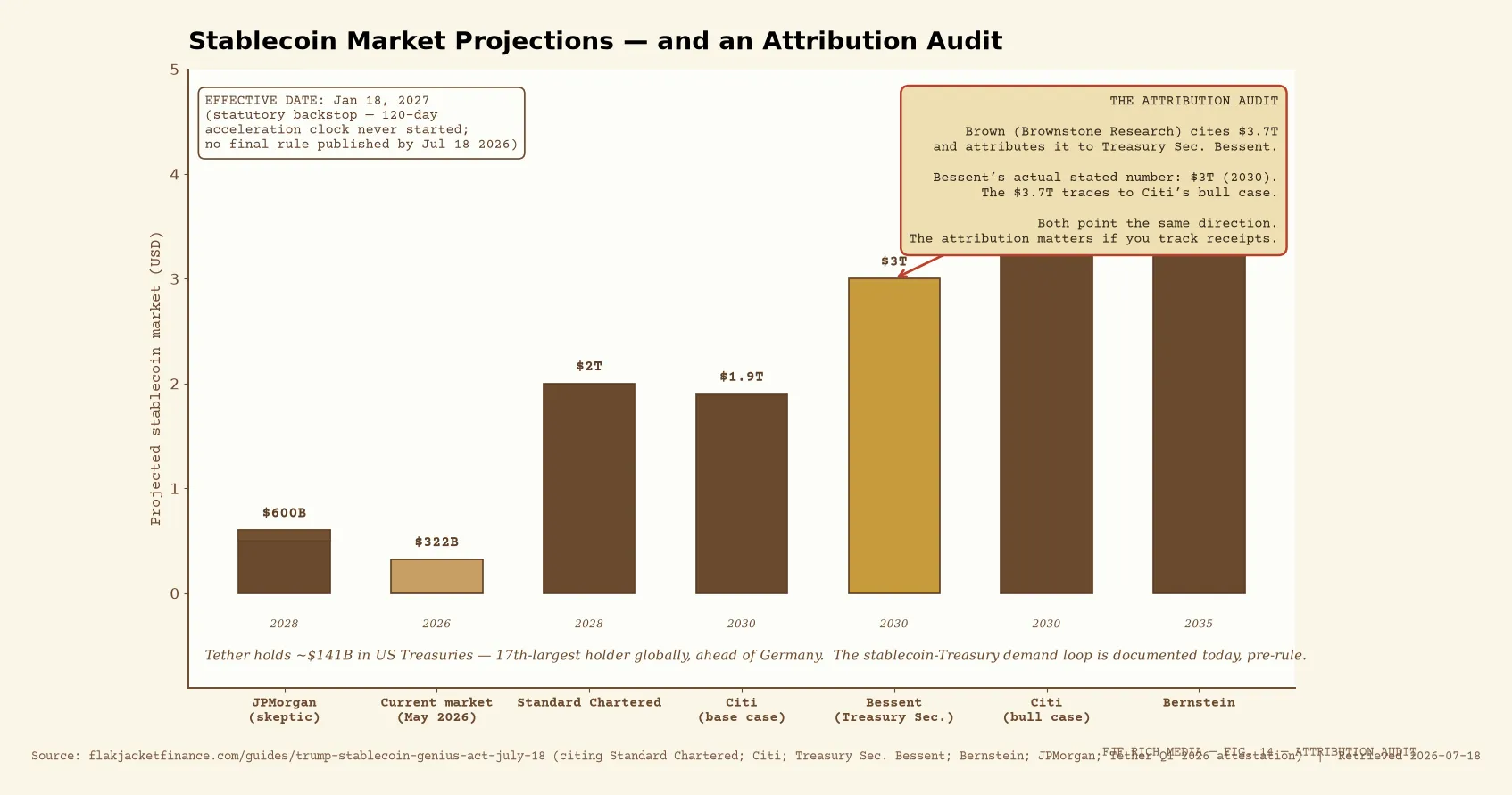
The law has no fallback for a blown deadline. The effective-date formula keeps running: the GENIUS Act takes effect on the earlier of January 18, 2027 — eighteen months after enactment — or 120 days after regulators finalize their rules. Because no final rule has issued, the 120-day acceleration clock has never started. January 18, 2027 is the operative date.
That is the regulatory reality. The promotional reality running ahead of it has been something else entirely.
What the GENIUS Act Actually Does
President Trump signed the Guiding and Establishing National Innovation for U.S. Stablecoins Act into law on July 18, 2025. It is the first federal framework for payment stablecoins — digital tokens pegged to the U.S. dollar and redeemable at par.
The mechanics are straightforward. Only a “permitted payment stablecoin issuer” may legally issue a payment stablecoin to U.S. persons once the Act is fully effective. Three pathways exist: a subsidiary of an insured depository institution, a federally licensed non-bank issuer, or a state-qualified issuer under a regime certified as “substantially similar” to the federal standard. Issuers above $10 billion in outstanding stablecoins must operate under federal supervision.
Reserves must be 100% backed by liquid assets — cash, Federal Reserve balances, insured deposits, short-dated Treasury bills, overnight Treasury repos, and government money market funds. Corporate bonds, equities, commercial paper, crypto, and gold are not permitted. Reserves cannot be rehypothecated. Monthly attestations by a registered accounting firm are required. Issuers become financial institutions under the Bank Secrecy Act, with the same AML and sanctions obligations as banks. Issuers cannot pay interest or yield directly to stablecoin holders.
The White House fact sheet from signing day framed the law as a Treasury-demand mechanism: stablecoin issuers backing their tokens with Treasuries would generate structural demand for U.S. government debt and cement the dollar’s reserve-currency status.
The Two Pitches
Two publishers built monetary-system theses on top of this law, and both pegged their catalyst to July 18.
Jeff Brown at Brownstone Research hosted what he called an emergency Project MAFA briefing on July 16, 2026 — two days before the deadline. The thesis: every stablecoin issued becomes a micro-purchase of U.S. government debt, creating what Brown calls a “circular dollar system” where domestic digital-asset demand replaces foreign creditors. Treasury Secretary Scott Bessent, Brown told his audience, projects the stablecoin market reaching $3.7 trillion. The product behind the pitch is Permissionless Investor, a $2,500 crypto research service.
Eric Wade at Stansberry Research ran a separate campaign around the same date — the “25th floor of Trump Tower” pitch — built on real-world-asset tokenization. Wade’s angle is the infrastructure layer: the tokenization of real estate, private credit, and other assets that the stablecoin rails make possible. The July 18 regulatory deadline was the catalyst hook. The product is Crypto Capital, a $2,500-per-year Stansberry service with a 90-day credit-only guarantee.
Two gurus, two publishers, two angles on the same statutory date.
The Numbers Behind the Thesis
The structural argument is not invented. Tether, the largest stablecoin issuer, holds approximately $141 billion in U.S. Treasury exposure as of its Q1 2026 attestation — making it the 17th largest holder of U.S. government debt globally, ahead of Germany. Circle, the second-largest issuer, parks roughly 80% of USDC reserves in a BlackRock-managed government money market fund that buys nothing but T-bills and overnight repos. The combined stablecoin market crossed $322 billion in May 2026, surpassing the foreign exchange reserves of 95 nations.
The projections diverge by source. Standard Chartered puts the market at $2 trillion by end of 2028. Citi’s base case is $1.9 trillion by 2030, with a bull case of $3.7 trillion — the figure Brown cites. Bessent himself, in his most recent public remarks, raised his own projection to $3 trillion by 2030, up from a prior $2 trillion. Bernstein projects $4 trillion by 2035, while JPMorgan, the skeptic in the room, sees $500-600 billion by 2028.
Brown attributes the $3.7 trillion figure to Bessent, but the Treasury Secretary’s actual stated number is $3 trillion. The $3.7 trillion traces to Citi’s bull case. Both numbers point the same direction; the attribution matters if you are tracking receipts.
What the Deadline Miss Actually Means
The agencies have not been idle. Five proposed rules landed between February and May 2026: the OCC licensing framework, the FDIC prudential standards, the NCUA credit-union rules, the Treasury state-certification principles, and the FinCEN/OFAC anti-money-laundering rules. The NCUA comment period closed July 17 — one day before the statutory deadline. That is how close to the wire this ran.
What the miss means in practice is less dramatic than it sounds. The statute’s core obligations are already fixed in law: 1:1 reserves, permitted asset classes, no yield to holders, monthly attestations, Bank Secrecy Act status. The rules add the prudential detail — the $5 million minimum capital floor the OCC proposed, the same-day liquidity buffers, the two-business-day redemption window, the sanctions-screening requirements. The direction is set, even as the exact numbers continue to be negotiated through open comment periods.
What the miss means for the promotional theses is sharper. Both Brown and Wade framed July 18 as the moment regulatory clarity would unlock institutional capital flows, but the clarity is not here yet. The 120-day clock has not started, and issuers are preparing against proposed text rather than binding regulation. A final rule published after roughly September 20, 2026 cannot beat the January 18, 2027 backstop, which means the acceleration window is closing.
The Thesis Versus the Picks
The structural argument — that stablecoins create a new buyer of U.S. debt — works whether the rules land in November or January. Tether holding $141 billion in Treasuries is a fact today, under the current patchwork regime. The GENIUS Act codifies what is already happening — the practice predates the statute.
The picks argument is where the distance between thesis and investment gets wider. Brown’s pitch is that the companies building stablecoin infrastructure are the investment, and his paid reports name specific stocks. Wade works a parallel angle on real-world-asset tokenization — the conversion of real estate, private credit, and other physical or financial assets into blockchain-tradable tokens that the stablecoin rails make liquid. Neither guru names their specific picks in free presentations, and the picks solved by third-party de-tease sites originate from paid products — those company names stay internal.
The history worth carrying into this is the petrodollar. The 1974 deal that recycled Saudi oil dollars into Treasuries was a real structural demand mechanism, and it worked for decades. It did not, however, make every oil-services stock a winner, and the companies that captured the infrastructure rents were not always the ones the promotional copy of the era highlighted. The stablecoin-Treasury loop is a genuine monetary architecture shift. The specific stocks riding that shift are a separate question, and the answer depends on adoption curves the rulebook has not yet locked in.
What to Watch
The date that actually matters is January 18, 2027. That is the statutory effective date, and it governs unless a final rule publishes by roughly September 20 to pull it forward. Watch for final rules from the OCC and Treasury first — those carry the licensing and state-certification frameworks that determine who can legally operate. Watch the Federal Reserve, which has yet to propose its piece at all. Watch the Stablecoin Certification Review Committee, which has not certified a single state regime.
The July 18 deadline was a statutory date that the pitches repurposed as a catalyst. The gurus who built monetary-system theses around it were reading a genuine structural shift — the stablecoin-Treasury demand loop is documented in the reserve data, distinct from the narrative the presentations layer on top of it. What they were not reading accurately was the rulemaking calendar. The regulators moved at the pace regulators move, and the statutory deadline turned out to be aspirational.
The verification trail is public. The law itself sits on congress.gov, the proposed rules are in the Federal Register, and Tether and Circle publish their reserve attestations monthly, which means the thesis is checkable from primary sources before touching any paid pitch. The specific stock picks are what is not checkable. That distinction separates the checkable thesis from the picks you would be paying for.
For more thesis and regulatory guides, browse the guides index.