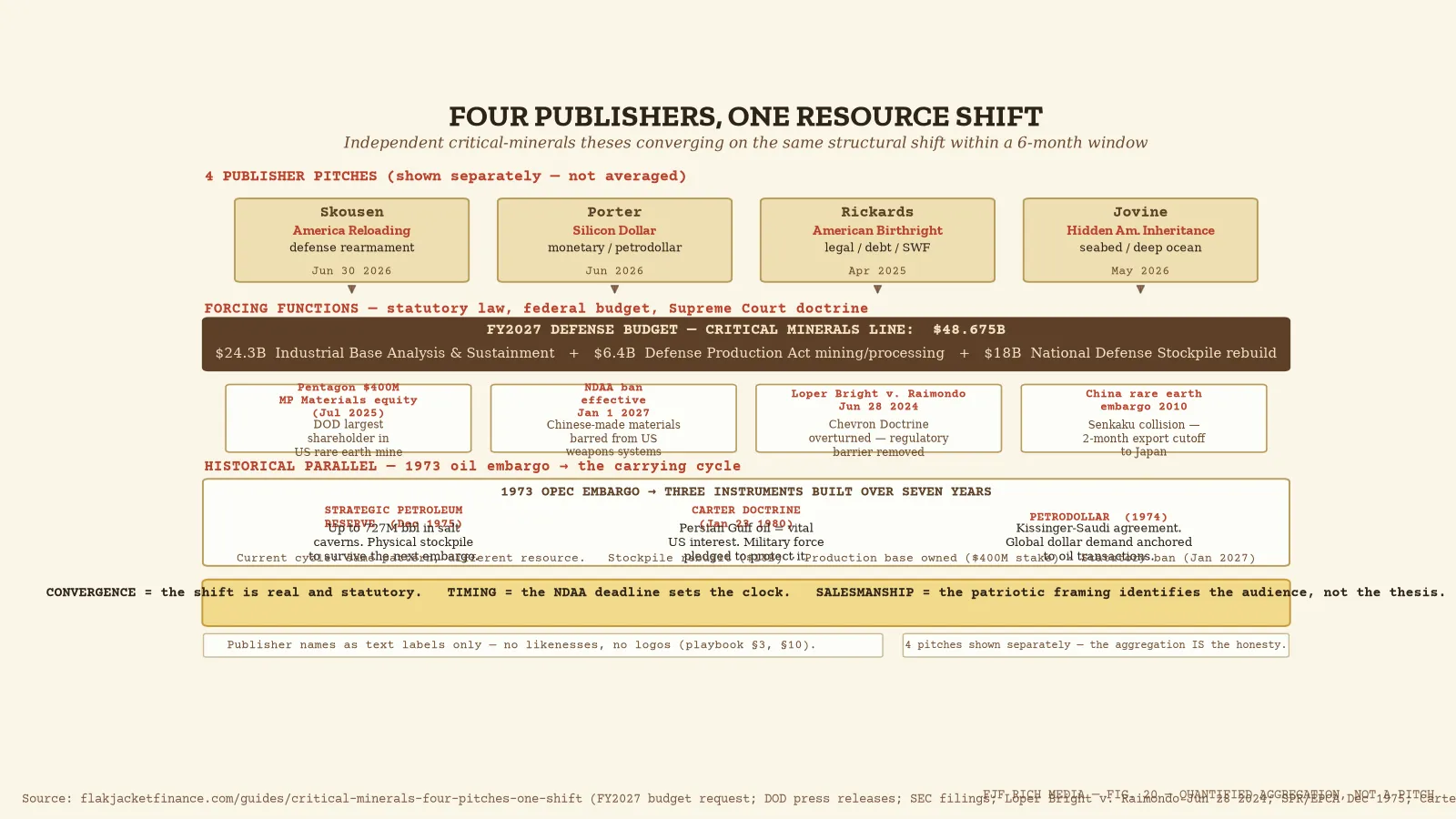
By the summer of 2026, four investment publishers operating independently had arrived at one thesis from four different angles and wrapped it in matching patriotic language: Mark Skousen at the Oxford Club called it America Reloading, Porter Stansberry at Porter & Co. called it the Silicon Dollar, Jim Rickards at Paradigm Press called it the American Birthright, and Dylan Jovine at Behind the Markets called it the Hidden American Inheritance. The names differ. The structural claim does not: the United States is reclaiming control of the physical materials behind its defense systems, its energy grid, and its AI infrastructure, and the companies building that supply chain are where the capital is heading.
The convergence is the signal. When four publishers at four different houses, with four different guru pedigrees, all frame their pitches around domestic resource reclamation as a national security imperative within a single six-month window, they are reading identical forcing functions. The forcing functions are statutory law, federal budget lines, and Supreme Court doctrine — not newsletter copy.
The four angles
Skousen’s America Reloading Summit ran June 30, 2026, hosted by the Oxford Club. His angle is defense rearmament. The pitch cites a planned $1.5 trillion defense buildout — the largest in 75 years — broken into $54 billion for drones, $65 billion for an 18-warship Golden Fleet, $102 billion for aircraft including F-35s and B-21 bombers, and $52 billion for munitions replenishment. The binding constraint, Skousen argues, is the materials — the budget can authorize spending, but nothing gets built if the materials inside those weapons are still controlled by the country they are meant to deter. China controls roughly 90 percent of rare earth processing capacity, and a Pentagon rule taking effect January 1, 2027 bans Chinese-made materials from American weapons systems entirely. Skousen spent the weeks before the summit digging through SEC filings and Pentagon contract notices to map the five companies he believes sit in the path of that spending. He cites his own CIA experience during the 1973 oil crisis as the frame — the lesson that a foreign supply shock exposes vulnerabilities the budget cannot fix.
Porter’s Silicon Dollar, published through Porter & Co. in June 2026, takes the monetary angle. The thesis: the 50-year petrodollar era is ending, and the Trump administration is engineering a successor anchored to AI infrastructure rather than oil. The State Department’s Pax Silica initiative, announced December 12, 2025, and the FORGE Alliance critical minerals ministerial in February 2026 are the diplomatic instruments. Porter’s investment frame is “own the toll roads, not the traffic” — find the chokepoints in the new supply chain where capital has no choice but to flow through. His crossover presentation with Luke Lango, “America’s New 1776 Moment,” wraps a shared structural thesis in the patriotic language of a 250-year paradigm shift.
Rickards’ American Birthright, released through Paradigm Press beginning April 2025, takes the legal-and-debt angle. Rickards argues that $150 trillion in mineral wealth sits beneath federal lands, locked by a century of regulatory obstruction, and that the Supreme Court’s June 2024 overturn of the Chevron Doctrine removed the final barrier. He traces the legal framework to Title 30 of the U.S. Code, originally enacted by the 42nd Congress, and frames the resource unlock as a way to address the national debt through a sovereign wealth fund backed by federal mineral assets. The “birthright” language is explicit — he calls it a national inheritance left on the shelf.
Jovine’s Hidden American Inheritance, through Behind the Markets, takes the seabed angle. Where the other three look at federal lands, Jovine looks at the deep ocean floor — the polymetallic nodules containing nickel, cobalt, copper, and manganese. His thesis relies on NOAA permitting milestones in May 2026 that advanced the regulatory framework for commercial deep-sea collection. The access mechanism is different; the structural claim is identical: the materials behind defense and technology must come from somewhere the United States controls. For the parent pitch, see Hidden American Inheritance: What Dylan Jovine Found, and for Porter’s monetary-angle take on the same resource shift, see Porter’s Silicon Dollar: The Petrodollar Replacement.
What the convergence is actually reading
The forcing functions underneath all four pitches are public record.
The FY2027 defense budget request pre-commits $48.675 billion to Critical Minerals as a single appropriation line — $24.3 billion for the Industrial Base Analysis and Sustainment program, $6.4 billion in Defense Production Act purchases for mining and processing, and $18 billion to rebuild the National Defense Stockpile. The Pentagon took a $400 million equity stake in MP Materials in July 2025, making the Department of Defense the largest shareholder in America’s only operational rare earth mine. The NDAA provision expanding the Chinese-materials ban takes effect January 1, 2027. The Supreme Court overturned the Chevron Doctrine in Loper Bright Enterprises v. Raimondo on June 28, 2024, dismantling the regulatory framework that had governed federal land use interpretation for forty years. China imposed rare earth export controls in 2023 and tightened them through 2025.
Each guru built a pitch around a subset of these facts: Skousen read the defense budget and the NDAA deadline, Porter read the diplomatic architecture and the chokepoint logic, Rickards read the legal doctrine and the debt connection, and Jovine read the seabed permitting and the supply gap. The convergence is four independent readers arriving at an identical structural conclusion from different primary documents — not coordination.
The historical parallel that carries the thesis
The parallel that matters is the one Skousen himself cites. In October 1973, OPEC embargoed oil exports to the United States in retaliation for support of Israel. The price of a barrel quadrupled in months. Gasoline lines stretched for blocks. The crisis exposed a structural vulnerability: the American economy and military ran on a resource controlled by adversarial nations.
The policy response took seven years and built three instruments. The Strategic Petroleum Reserve was created by the Energy Policy and Conservation Act of December 1975 — a physical stockpile of up to 727 million barrels of crude stored in salt caverns along the Gulf Coast, designed to survive the next embargo. The Carter Doctrine, articulated in the January 23, 1980 State of the Union address, declared Persian Gulf oil a vital U.S. interest and pledged military force to protect it. The petrodollar system, quietly structured by Henry Kissinger’s 1974 agreement with Saudi Arabia, anchored global dollar demand to oil transactions. Each instrument addressed a different layer of a shared vulnerability — the physical stockpile, the military doctrine, the monetary architecture.
The current cycle is running an identical pattern against a different resource. The triggering shock was China’s 2010 rare earth embargo against Japan — the Senkaku Islands collision that cut off rare earth exports for two months and terrified Tokyo and Washington. The policy response has been slower but structurally parallel. The FY2027 budget rebuilds the National Defense Stockpile at $18 billion — the identical instrument, created after World War II for the identical reason, neglected through the post-Cold War era, now restored for the next embargo. The Pentagon’s equity stake in MP Materials is the modern equivalent of the Carter Doctrine’s military commitment — the government declaring a domestic production base a vital interest worth owning directly. The NDAA’s January 2027 ban is the regulatory equivalent of the SPR’s creation — a statutory mechanism to survive a supply cut.
Porter’s Silicon Dollar thesis is the monetary layer — the argument that the resource anchor is shifting from oil to AI infrastructure the way it shifted from gold to oil in 1971 and from sterling to dollars in 1944. Whether that monetary claim holds is a separate question from whether the supply chain rebuild is real. The supply chain rebuild is statutory law with a date certain.
The pattern that recurs
The pattern across both cycles is that a foreign supply shock exposes a dependency, the government responds with a physical stockpile and a production subsidy, the stockpile is underfunded for decades, and then a second shock or a statutory deadline restarts the cycle. The Strategic Petroleum Reserve was drawn down repeatedly after 1975 and reached historically low levels before being refilled. The National Defense Stockpile was drawn down to near-zero by the 2000s — the FY2027 request notes the stockpile holds roughly 42 days of one critical material. Both stockpiles were created by leaders who understood the vulnerability and neglected by successors who did not.
The investment thesis in both cycles was identical: own the companies building the domestic production base the government has decided to fund. In the 1970s cycle, that meant Exxon, Lockheed, and the shale pioneers. In the current cycle, it means the rare earth processors, the nickel miners, the antimony developers, and the seabed collectors — each at a different stage of the build sequence, each with a different mix of government contracts and dilution risk. The SEC filings of every company attempting to close the gap tell a story the press releases do not: some have binding offtake agreements, most have non-binding term sheets, and the dilution across the sector has been severe.
Where the patriotic framing fits
The America-250 framing — the July 4, 2026 semiquincentennial — is the marketing vehicle that makes a slow-moving industrial policy story feel urgent. Multiple publishers tied their pitches to the anniversary. The structural thesis does not depend on the anniversary. The NDAA deadline is January 1, 2027, not July 4, 2026. The Pentagon’s equity stake was July 2025, the Chevron overturn was June 2024, and the China embargo was 2010. The timeline runs on statutory and judicial clocks, not patriotic ones.
The patriotic language reaches the audience most receptive to a domestic-production thesis. The readers who respond to “American Birthright” and “America Reloading” and “1776 Moment” framing are the readers who already believe domestic production is a national priority. The framing identifies the audience; the thesis is supply chain reclamation backed by statutory law, federal budget lines, and Supreme Court doctrine.
What the convergence tells you
When four publishers, operating independently, all point their subscribers at a shared structural shift under matching patriotic framing within a single window, they are reading the same public record: the NDAA deadline is statutory law, the Pentagon’s equity stake is an SEC-filed transaction, the FY2027 budget request is a line item Congress can read, the Loper Bright decision is a Supreme Court opinion, and the China export controls are published trade policy. Every one of these facts is verifiable in primary sources, and every one of them predates the marketing copy built on top of them.
The supply chain rebuild is real and the statutory deadline makes it measurable. The investment question is which companies can execute on the timeline the law demands, how much of the upside the government captures through its price floors and equity stakes, and how much of the patriotic framing is thesis versus how much is salesmanship. The SEC filings, the NDAA text, and the Senate testimony from February 2026 are where the answer lives. The promos are where the urgency comes from. For the stock-level coverage of the NDAA deadline, see Critical Minerals Stocks 2026: The Deadline. For the full guides index, see Guides.