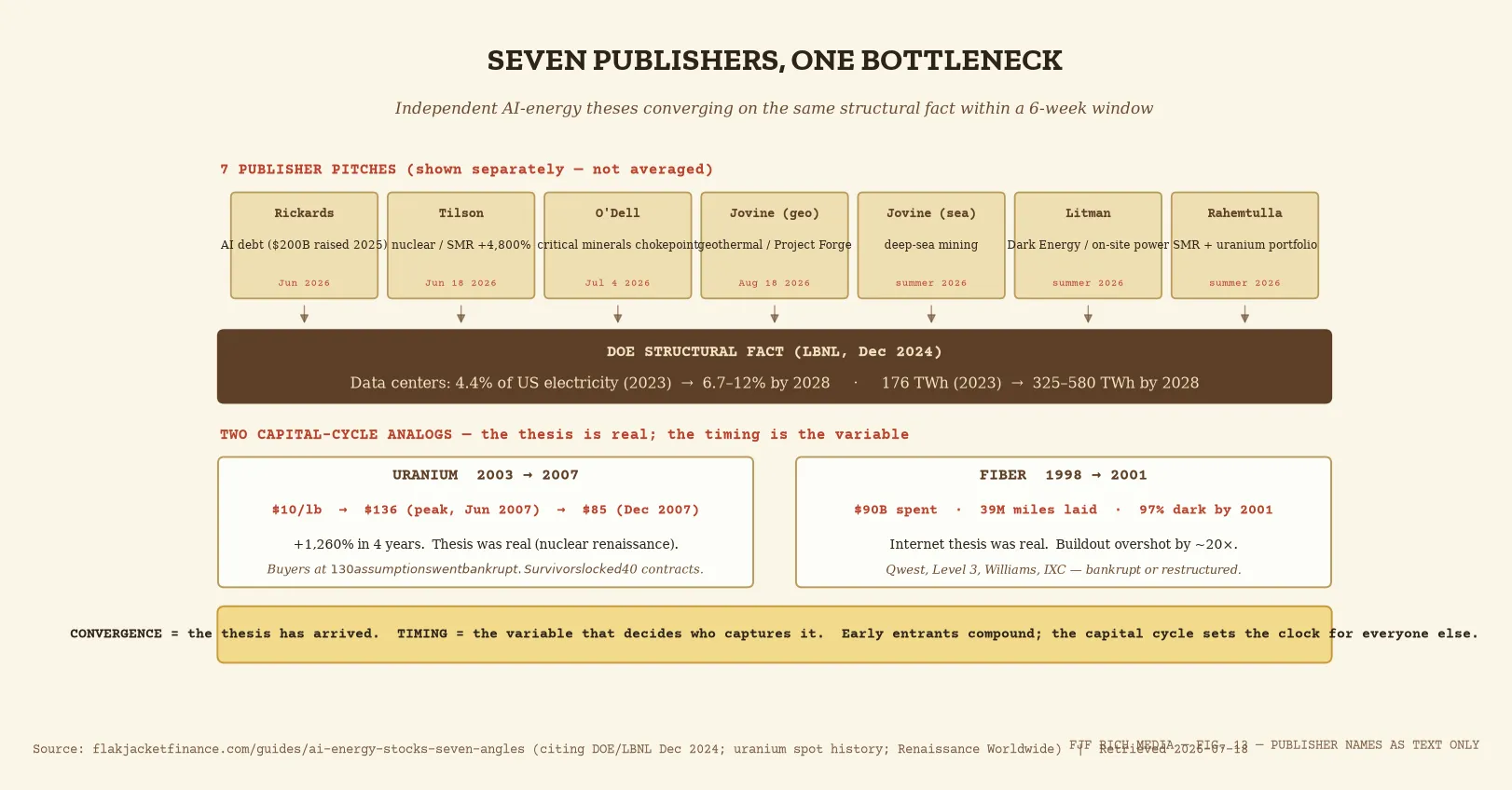
By the summer of 2026, the AI buildout had run into a constraint that compute cannot solve. The constraint is electricity, and roughly seven investment publishers arrived at that conclusion independently within a six-week window. The thesis is real and the convergence is the signal — and the history of crowded structural-thesis trades says the timing is the variable that decides who captures it.
The structural fact underneath all of them
The U.S. Department of Energy’s Lawrence Berkeley National Laboratory found that data centers consumed 4.4% of total U.S. electricity in 2023 and projects that figure to reach between 6.7% and 12% by 2028. Total data center electricity usage climbed from 58 terawatt-hours in 2014 to 176 TWh in 2023, with an estimated increase to between 325 and 580 TWh by 2028. That is the structural fact every one of these publishers built their summer campaigns around, and it is a federal research estimate published in December 2024 — sourced data, distinct from the marketing claims layered on top of it downstream. We unpacked what that projection means for the grid in the AI data center energy crisis guide.
What each publisher found
Jim Rickards, publishing through Paradigm Press, released a free presentation in June 2026 called the AI Black Paper. His angle is the debt. AI-related companies and projects raised at least $200 billion through debt markets during 2025, Rickards says, and he argues the critical question is who holds that debt when the spending projections soften. He pegged July 29 — Meta’s earnings date — as the moment the next read on those spending projections arrives. The full Rickards AI-debt line is tracked in the $236 billion AI debt breakdown.
Whitney Tilson, writing for Stansberry Research’s Commodity Supercycles letter, went public with his enthusiasm in a June 18, 2026 article titled “The big investment theme I’m most excited about right now.” His angle is nuclear. He argues that small modular reactors will slowly replace the world’s 3,000-plus coal plants and that the SMR market, worth roughly $6 billion today, will grow 4,800%. He also pitches a uranium supply shortfall of 40 million pounds per year for the next decade. We sized the SMR delivery gap against Big Tech’s announced deals in the small modular reactors for AI data centers guide.
Adam O’Dell, through Banyan Hill, built a campaign called Criticality Shock around the critical-minerals chokepoint, with a July 4 deadline pegged to the America-250 framing that drove several summer campaigns. His angle is the minerals supply chain — the rare earths, copper, and graphite that data center hardware and grid infrastructure require. A July 16, 2026 report from the International Energy Agency noted that China’s rare earth export curbs could affect $6.5 trillion in downstream global production — the IEA’s framing of the supply picture O’Dell’s thesis rests on. The supply-chain rebuild behind that framing is tracked in the critical minerals stocks 2026 guide.
Dylan Jovine, at Behind the Markets, split his energy thesis into two campaigns: one around geothermal power with an August 18 catalyst date, and one around deep-sea mining for the metals the energy transition demands. The geothermal arm is the Last Energy Revolution pitch, built around Utah’s Project Forge and a Google-signed 15-year PPA.
Joel Litman, through Altimetry, built a campaign around what he calls the Dark Energy play — on-site power generation for AI compute, bypassing the grid entirely. The same dark-energy framing runs through the SpaceX dark-energy $10 trillion boom thesis, where Litman’s on-site power angle crosses into the Musk-empire buildout.
Karim Rahemtulla, at Monument Trend, pitched an SMR and uranium portfolio.
Each of these publishers works independently. They use different methodologies, different data sources, and different stock selection frameworks. They arrived at the same structural conclusion from different directions within the same six-week window.
The uranium bubble of 2007
In 2003, uranium spot traded around $10 per pound. By June 2007, it peaked near $136 — a 1,260% increase in four years. The thesis was nuclear renaissance: China and India were building reactors, the Cigar Lake mine in Saskatchewan had flooded, and secondary supplies from decommissioned weapons were running down. Nuclear capacity did grow through the cycle. The spot price collapsed to $85 by December 2007 and spent the next decade below $50.
The companies that bought uranium mines at $130-per-pound assumptions went bankrupt. The companies that survived were the ones that had locked in long-term contracts at $40 and waited for the cycle to turn. The capital cycle had overshot the thesis — too many dollars chased the same structural fact, and the late entrants funded the exits of the early ones. The pattern of a real thesis monetized by a crowded field is that the thesis compounds for whoever entered early and priced it right, and the capital cycle sets the timing for everyone else.
The fiber glut of 1999 to 2001
The parallel is closer than it looks. Between 1998 and 2001, telecommunications companies spent roughly $90 billion laying 39 million miles of fiber-optic cable under U.S. soil. By 2001, 97% of that capacity lay dark — unlit, unused, carrying no data. Renaissance Worldwide estimated that data traffic could grow 18-fold in two years while network capacity grew 400-fold. The Internet thesis was real. The buildout overshot it by a factor of twenty.
The companies that laid the fiber — Qwest, Level 3, Williams Communications, IXC — either went bankrupt, restructured, or sold themselves for fractions of their build cost. The companies that bought the fiber out of bankruptcy at pennies on the dollar were the ones that made the money. Building capacity ahead of demand with borrowed money shifted the returns to the buyers who came in after the shakeout — the capital cycle’s way of separating the thesis from the entry point.
What the convergence means
When seven independent observers with different methodologies arrive at the same structural conclusion within weeks of each other, the structural conclusion is usually right. The DOE data confirms it. The PJM Interconnection auction failures confirm it — the grid operator serving 65 million people across 13 states failed for the third consecutive time in July 2026 to secure enough electricity to guarantee reliability, with a shortfall of 6.8 gigawatts. The Microsoft-Constellation deal to restart Three Mile Island confirms it. The AI buildout has hit a physical constraint, and the constraint is electricity.
What the uranium and fiber episodes dimensionalize is how a real thesis gets monetized once the convergence arrives. The structural fact stays true and the capital cycle still decides who captures it — the thesis compounds for early entrants who priced it right, and the capital cycle sets the timing for everyone else. The uranium bubble and the fiber glut are the two cleanest data points on what that timing looks like in practice. The convergence is the signal that the thesis has arrived; the timing is the variable that decides which side of the distribution a given entry captures.
The $200 billion in AI debt raised in 2025 is the number that links the structural thesis to the capital-cycle timing. The spending projections and the demand behind them are what carry the debt through. The July 29 earnings cycle and the quarters that follow will produce the next reads on those projections — exactly the framing Rickards uses, and the same transmission structure Enron’s off-balance-sheet vehicles used to carry the 2001 telecom collapse from the debt side.
What the thesis plays out through
The thesis is real, and the picks are where the publishers’ portfolios sit. Every one of these publishers is selling a specific portfolio of stocks tied to the AI-energy bottleneck, and every one of those portfolios is self-reported — the track record is the publisher’s, in the publisher’s own format, with no independently verified ledger behind it. The structural fact that data centers need power is the same kind of fact that powered the uranium renaissance and the fiber buildout — a real thesis underneath specific stock picks whose distribution the thesis alone does not determine.
The thesis plays out through a handful of concrete milestones. Uranium spot prices are the running read on the SMR and nuclear fuel cycle. The Darlington BWRX-300 construction milestone is the anchor project for the SMR thesis — its schedule shapes how the SMR delivery timeline reads. The performance of the $200 billion in AI debt raised in 2025 is the transmission line Rickards is tracking on the debt side. Those are the milestones that carry the thesis from a structural fact into specific entry points, and the picks sit downstream of every one of them.
For more thesis and convergence pieces, browse the guides index.